
Last updated September 20, 2026
Free on-site gate assessment - hinges, posts, and your LiftMaster or Nice gate operator checked before anything is quoted
The assessment is free and the quote is the invoice.




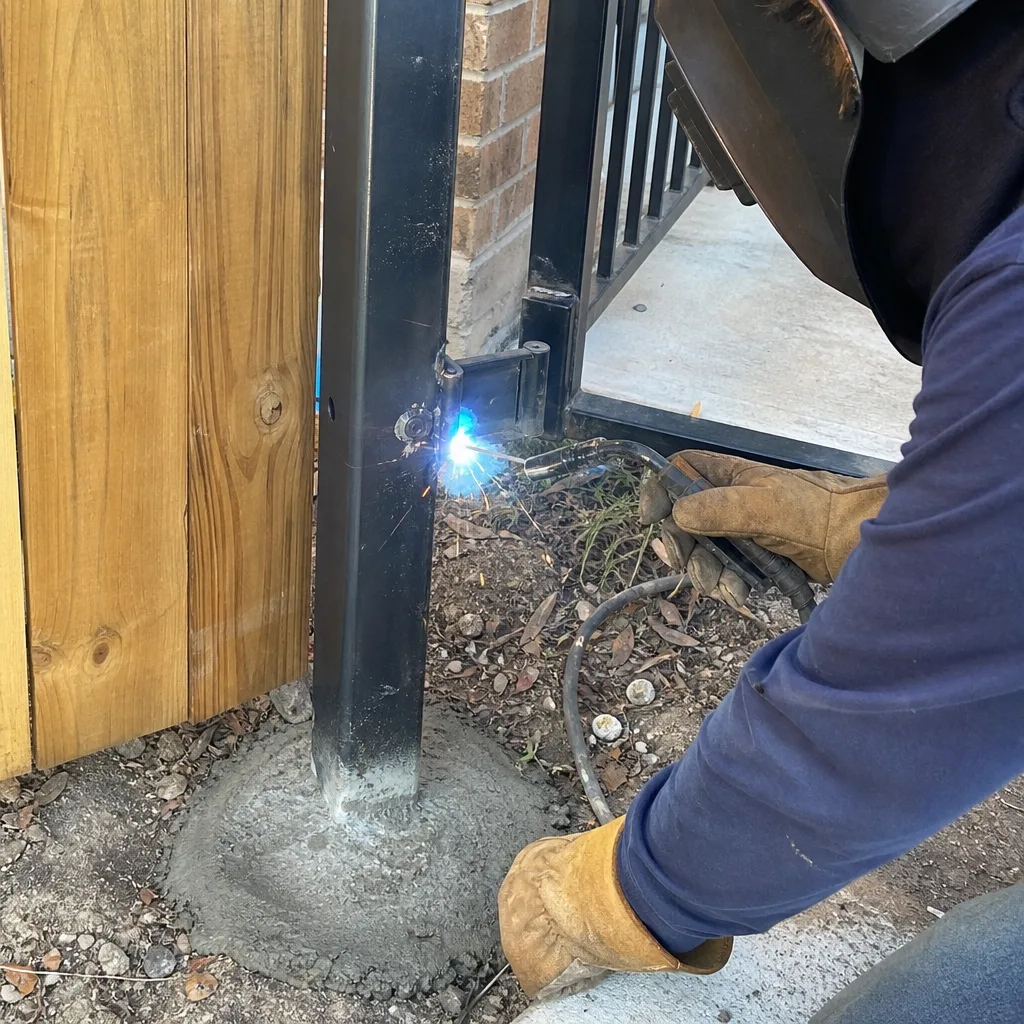
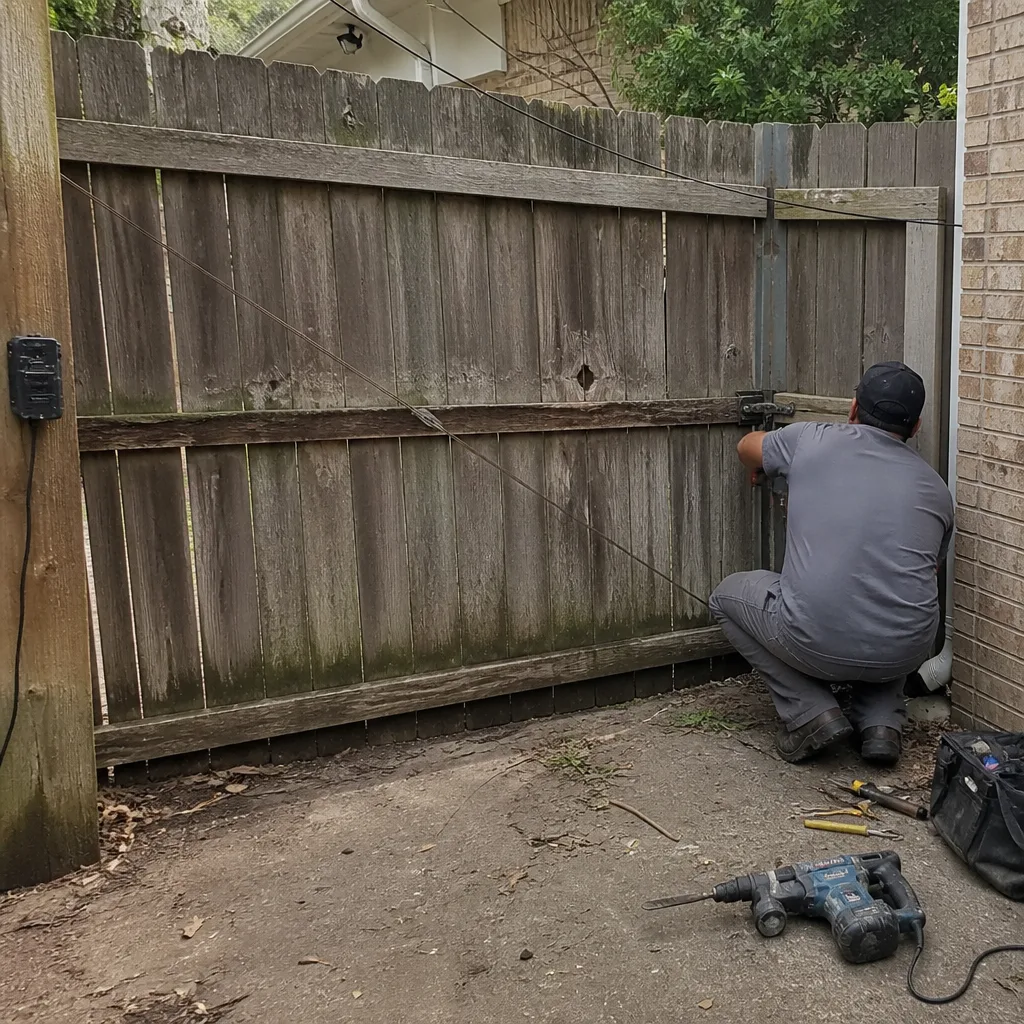 Before
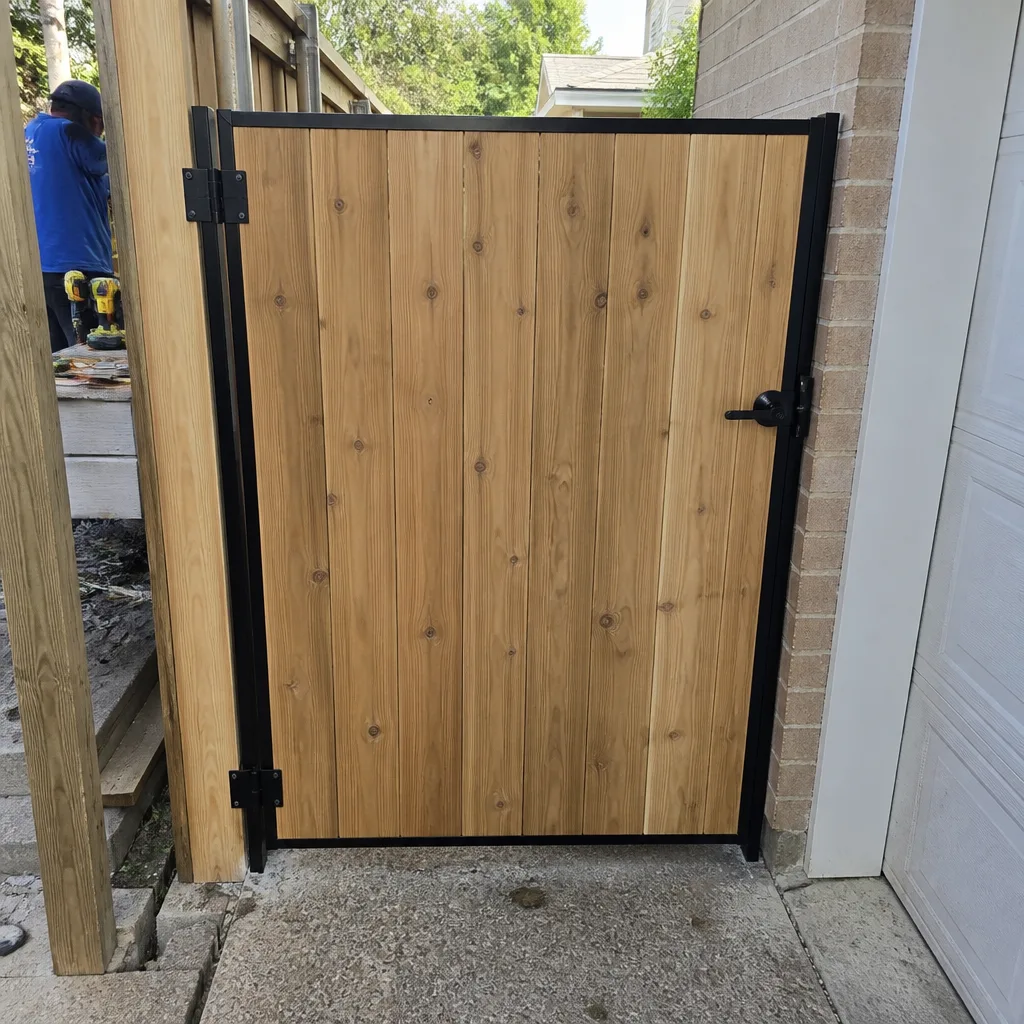 After
After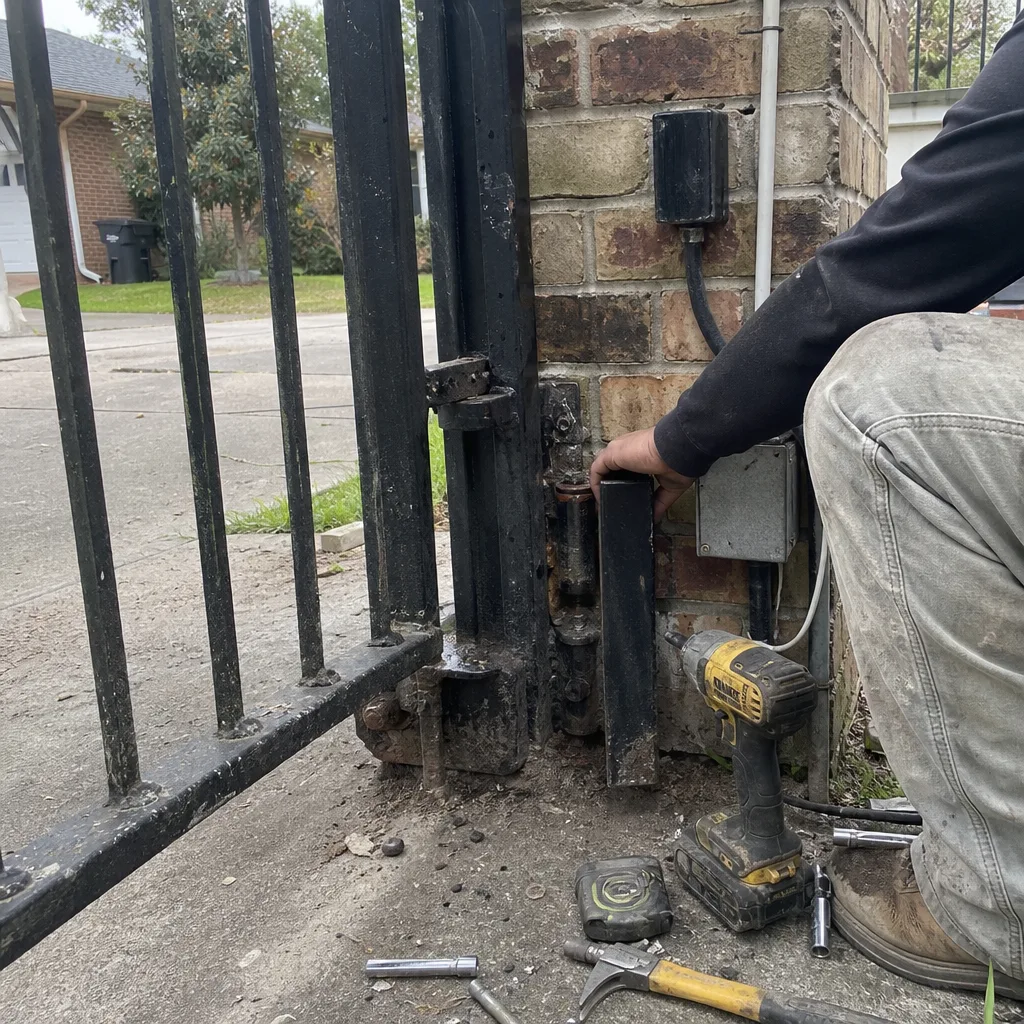 Before
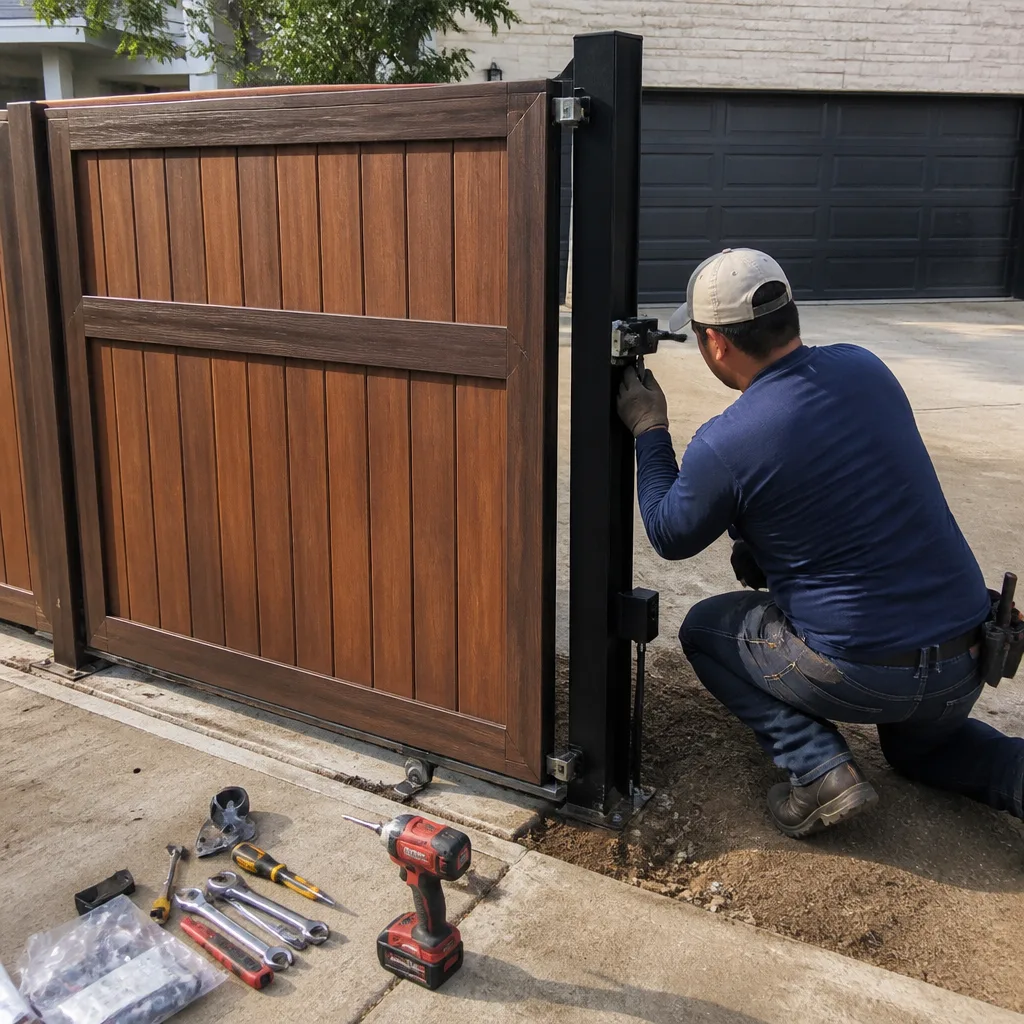 After
After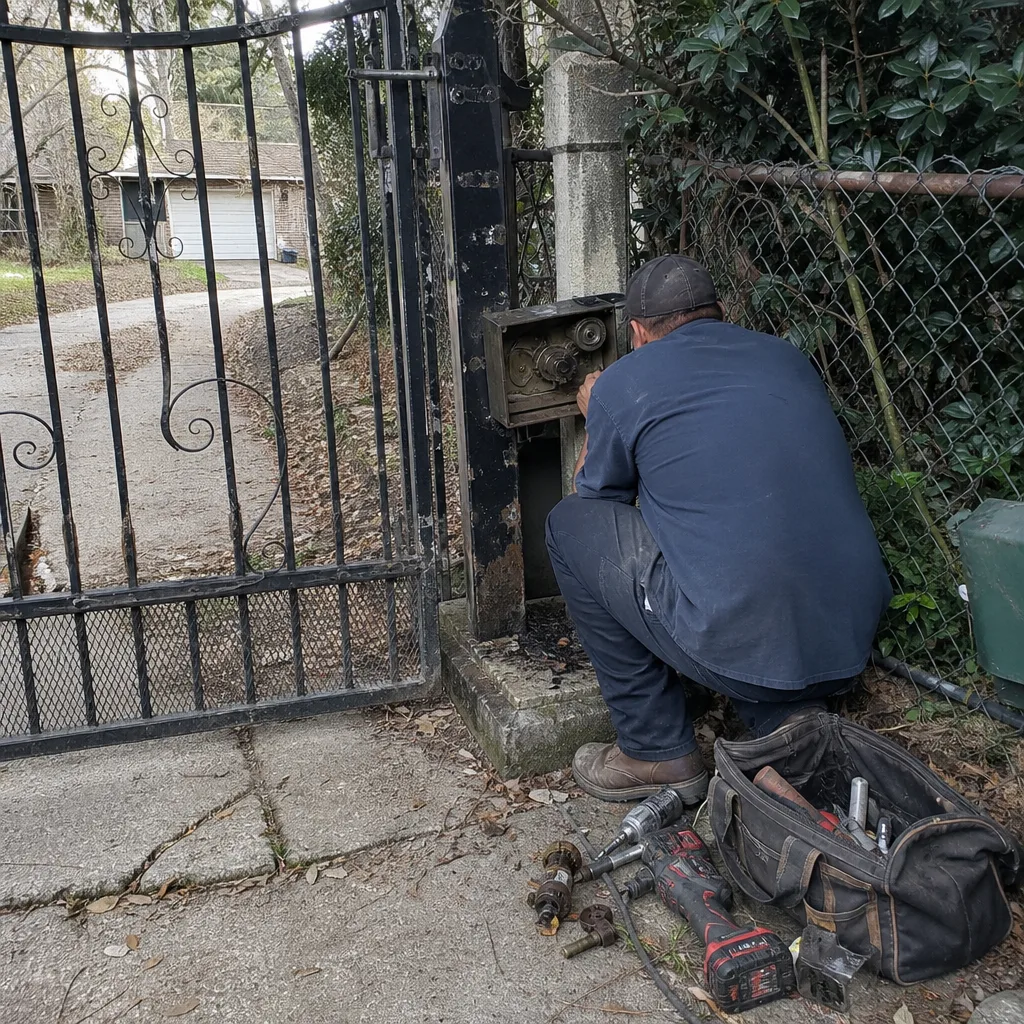 Before
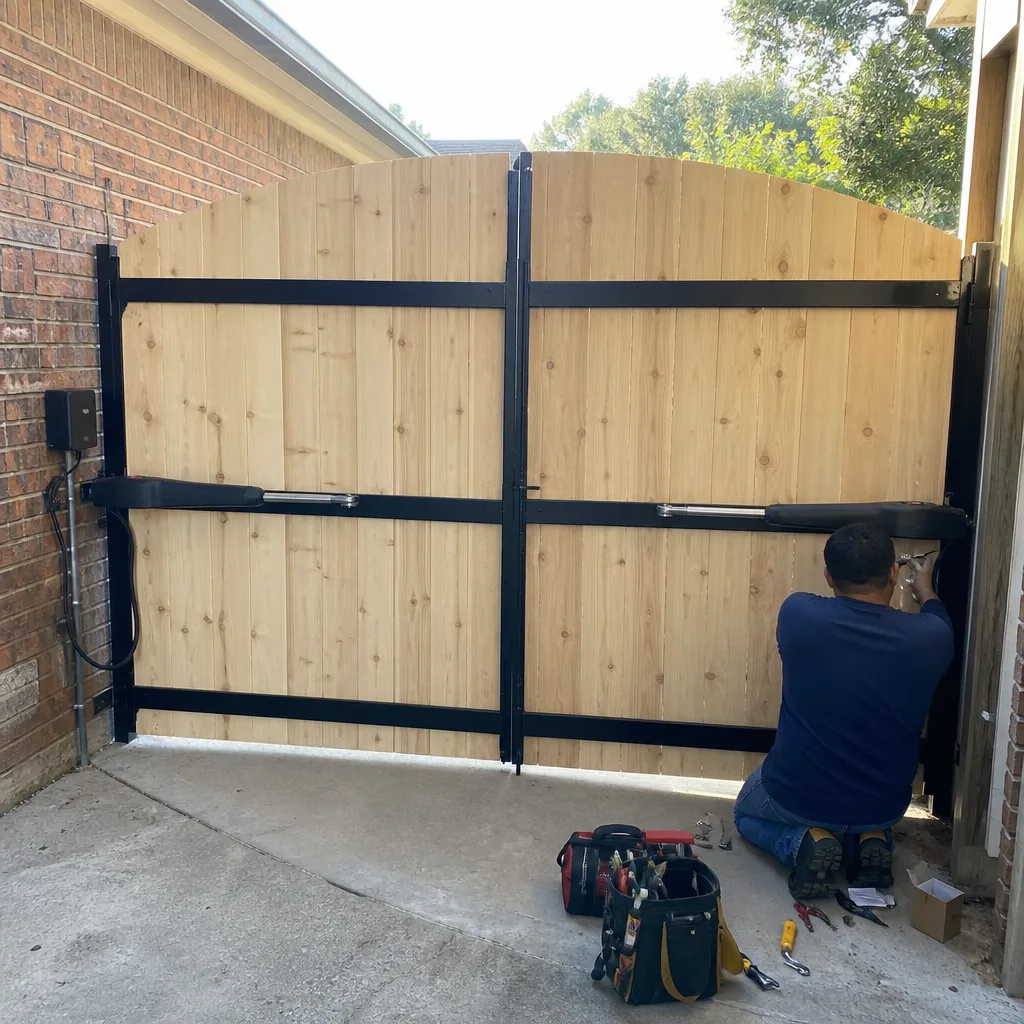 After
AfterGate Repair Maintenance Checklist for League City Homeowners
Every gate technician who has shown up to a “sudden failure” has seen the same thing: a maintenance log full of “checked and lubricated” entries and zero recorded measurements. That means no one can prove when the problem actually started. A maintenance checklist without baseline readings is just a list of things to look at. The version League City homeowners actually need records limit-switch positions, hinge gap measurements, and battery voltage so the next technician has numbers to compare, not impressions to guess from. This guide gives you the recording method, the pass/fail thresholds, and the seasonal adjustments that matter in League City’s specific climate.
Quick Answer
A useful gate maintenance checklist for League City records measurements, not just observations. Every quarter, document hinge gap in inches, battery float voltage, limit-switch travel position, and photo-eye alignment. Then photograph each component from the same angle every time. Those numbers tell the next technician exactly when a problem started, which means faster diagnosis and a repair price in writing before any work begins. For context on what to watch for, see our Gate Repair Warning Signs: A League City Homeowner’s Reference Guide.
Table of Contents
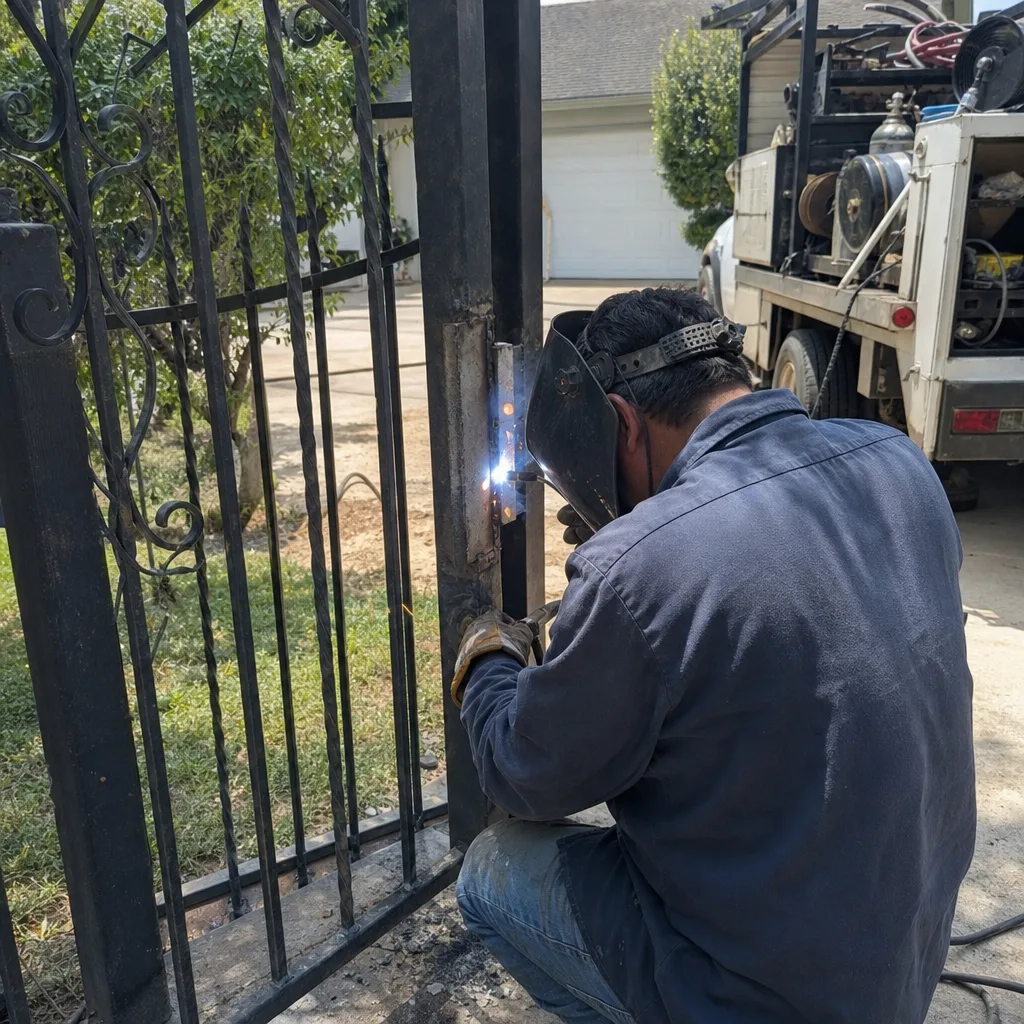
- Why Baseline Readings Matter More Than Visual Checks
- Hinge Gap Measurements: What to Record and What’s Normal
- Battery Float Voltage: The Number That Predicts Motor Failure
- Limit-Switch Position: Recording Travel Settings Every Quarter
- Photo-Eye Alignment and the Seasonal Drift Problem
- Lubrication: Silicone, Grease, or Nothing at All
- League City Seasonal Maintenance: What Changes in August vs. January
- How to Photograph Gate Components So Images Actually Help a Technician
- Pass/Fail Threshold List: When a Measurement Means Something Is Wrong
- Common Mistakes to Avoid
- When to Call a Professional
- Frequently Asked Questions
- The Bottom Line
BeforeAfterWhy Baseline Readings Matter More Than Visual Checks
Visual checks tell you a hinge is rusty. They don’t tell you the hinge gap grew from 3/16 inch to 5/16 inch over six months. That 1/8 inch of movement is the difference between a gate that swings quietly and a gate that’s slowly pulling itself out of square. By the time the sag is visible to the eye, the damage is already into the frame and possibly the operator. In our experience across League City, the gates that fail “without warning” are almost always gates that were never measured. Somebody lubed the wheels and called it maintenance. The gate was degrading on a schedule anyone could have seen, if anyone had written down a number.
Baseline readings turn maintenance into documentation. When a technician arrives at a gate that won’t open, the first question is always the same: what did it look like when it was working? If the homeowner can produce a log with hinge gap, battery voltage, and limit-switch position from three months ago, the diagnosis takes minutes instead of an hour. That speed translates directly to a lower repair bill. It’s also the difference between replacing a $40 part and replacing a $1,200 operator, because the early reading shows the part was failing before it took the motor down with it. We write every job record this way, and the checklist below is the homeowner version of that same habit.
For League City homeowners specifically, the climate makes this documentation more urgent. The humidity accelerates rust on untreated steel. The gumbo clay soil in many neighborhoods shifts with rainfall, which subtly changes gate post alignment season after season. A gate that passed a visual check in March can be measurably out of spec by September. Only a recorded number catches that drift before it becomes a repair. A visual check never will.
If you’re establishing baselines for the first time and the gate already has problems, start with our Gate Repair in League City page to understand what a documented repair actually includes.
Hinge Gap Measurements: What to Record and What’s Normal
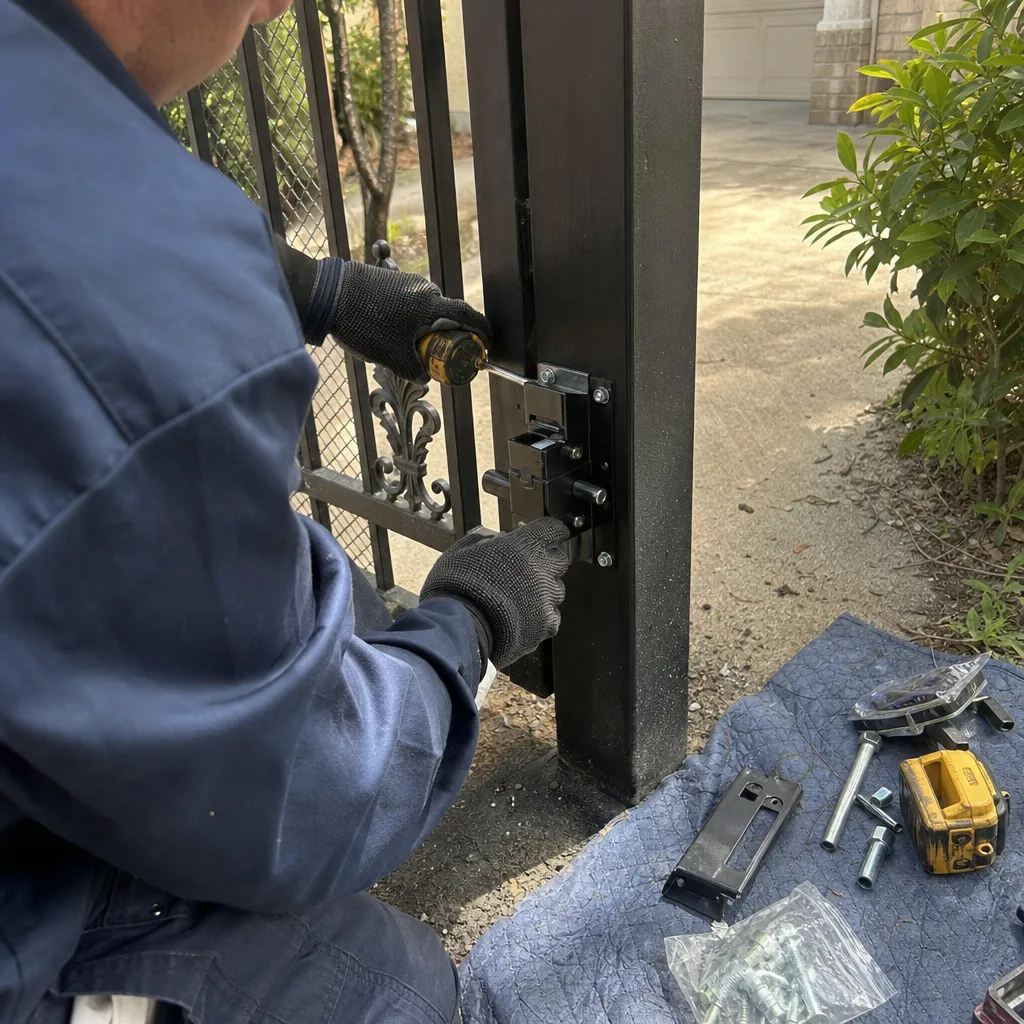
Hinge gap is the distance between the gate frame and the post at each hinge point. On most residential swing gates in League City, a healthy hinge gap is between 1/8 inch and 1/4 inch, measured with a simple feeler gauge or a steel ruler. Anything over 3/8 inch means the hinge is wearing, the post is leaning, or the gate was never hung square. Anything under 1/8 inch on a steel gate in humid air means the gap is closing because of corrosion buildup, and the gate will start binding when it swings.
Here’s how to record hinge gap properly:
- Measure at all hinge points, not just the top one. A gate has at least two hinges, often three on heavier gates. Write down the gap at each.
- Measure with the gate in the fully closed position. Then open it halfway and measure again. The numbers should be within 1/16 inch of each other. A bigger difference means the hinge pin is worn and the gate shifts as it moves.
- Write the date, the gate position, and the exact reading. “3/16 inch, closed” is a useful record. “Looks fine” is not.
- Compare to your previous reading. If the gap grew by more than 1/16 inch in a year, that’s the early warning. It’s not urgent if the gate still swings freely, but it’s moving and it won’t stop on its own.
On sliding gates, the equivalent measurement is the gap between the gate frame and the vertical track wheels, plus the gap under the gate at the guide rollers. Sliding gates in League City are common on new construction in master-planned communities, and the same principle applies: record the clearance at each wheel so wear shows up as a number before it shows up as a gate that drags.
Battery Float Voltage: The Number That Predicts Motor Failure
Every automatic gate with a backup battery has a float voltage, which is the voltage the operator board maintains on the battery when the gate is idle. For almost all residential gate operators, including LiftMaster and FAAC models, a healthy float voltage is between 13.2 and 13.8 volts DC, measured at the battery terminals with the gate closed and the operator plugged in. If the reading drops below 12.8 volts, the battery is no longer holding a proper charge. If it reads above 14.2 volts, the charging circuit is overcharging and will cook the battery within a season.
This one number is the cheapest early warning system in gate maintenance. A battery that’s failing will still open and close the gate for weeks, sometimes months, before it dies completely. The homeowner notices nothing, because the operator draws from the AC line when power is available. Then a thunderstorm knocks out power, the gate needs to cycle on battery, and it stalls halfway open. That’s not a sudden failure. That’s a battery that had been telling you it was dying for six weeks, if you’d only put a multimeter on it.
To record battery float voltage:
- Turn the gate operator off at the breaker or disconnect switch, wait 30 seconds, then turn it back on. This lets the board settle into steady-state charging.
- Set your multimeter to DC volts and place the probes on the battery terminals. The gate should be idle, not moving.
- Write down the exact reading to one decimal place. “13.6” is a record. “Battery seems fine” is worthless two months later when the gate fails.
- If the reading is below 12.8 or above 14.2, call for service. A battery replacement is under $200 on most systems. A failed battery that takes the operator board with it is a much larger bill.
We service nine automation brands including LiftMaster, FAAC, BFT, and Linear, so whatever board is on your gate, the voltage threshold is the same. The number doesn’t care about the brand. If your gate motor is doing something odd and you want a second set of eyes, see our Gate Motor & Opener in League City guide for what a proper diagnosis looks like.
Limit-Switch Position: Recording Travel Settings Every Quarter
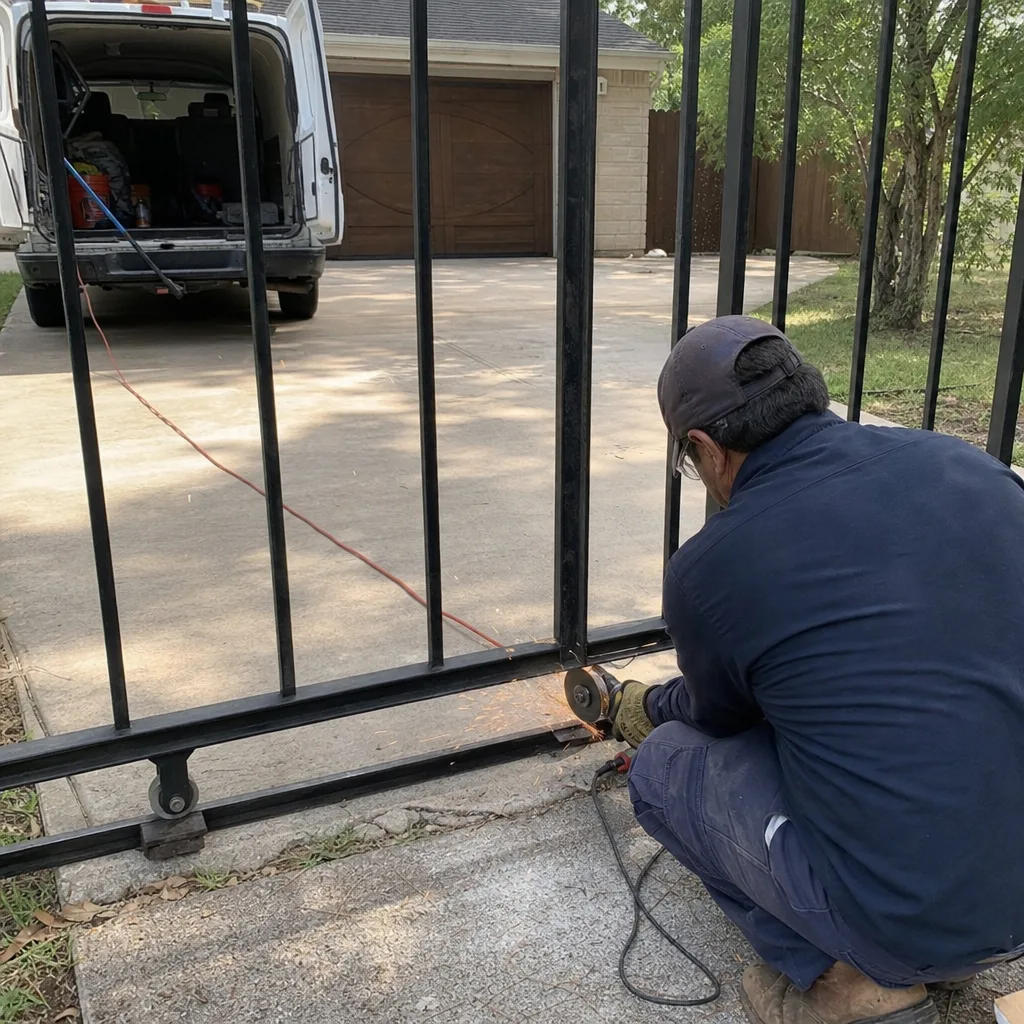
The limit switch tells the operator where the gate stops in the open and closed positions. On most modern operators, this is a digital setting stored in the board’s memory. On older mechanical units, it’s a physical cam or a magnetic sensor. Either way, the position drifts. Bolts loosen, gears wear, and a gate that used to stop exactly on the closed post slowly starts to over-travel or under-travel by a fraction of a degree each month.
Recording the limit-switch position means documenting where the gate stops relative to a fixed reference point. The easiest method: place a mark on the ground or the post where the gate’s leading edge meets the closed position, then measure the gap between the gate edge and that mark each quarter. Write it down in fractions of an inch. The same for the open position. If the gate swings past the post by 1/4 inch more than last quarter, the limit switch has drifted and the operator is now pushing against the post at the end of every cycle. That’s how bolts shear and gears strip, and it’s invisible until you measure it.
For the digital boards on LiftMaster operators, the board often displays a cycle count or a travel count in the diagnostic menu. If your board shows it, write that number down too. A gate that cycles 40 times a day will wear the operator much faster than a gate that cycles 8 times a day, and the cycle count tells you when the motor is approaching the service interval the manufacturer intended. Most residential operators are rated for a specific number of cycles before internal components need replacement. Knowing your count means knowing whether a $150 limit-switch adjustment is worth doing on a motor that’s already past its rated life.
If you don’t know how to access the diagnostic menu on your board, don’t guess. The wrong button sequence can wipe the travel settings and leave the gate inoperable. That’s a job for our Gate Repair services, not a maintenance task. We’ll read the board, record the settings, and photograph the screen so there’s a documented baseline.
Photo-Eye Alignment and the Seasonal Drift Problem
A photo-eye, also called a safety beam, is the infrared transmitter and receiver pair mounted near the bottom of the gate opening. If the beam is broken while the gate is moving, the gate stops or reverses. It’s a safety device, and it’s the most common source of “the gate won’t stay closed” calls in League City. The frustrating part is that the beam doesn’t fail all at once. It drifts. Post movement from gumbo clay soil, vibration from daily cycles, and even thermal expansion of the metal housing all shift the beam a fraction of a degree. One day the beam is still mostly aligned, and the gate closes. The next day, a gust of wind shakes the post and the gate reverses for no apparent reason.
You can check photo-eye alignment without touching anything. Look at the receiver unit. Most have an indicator LED that’s solid green or solid red when the beam is aligned, and blinking when the beam is marginal. A blinking LED is not a failure; it’s a warning. Record which unit blinks and when. Then use the photo method in the section below to photograph the transmitter and receiver housings from the same angle each quarter. If you see the housings have rotated even a few degrees relative to each other, the beam is drifting and will eventually lose alignment completely.
One League City-specific factor: afternoon sun. The low sun angle in winter can wash out the infrared beam on south-facing gate installations, making the receiver think the beam is blocked even when the path is clear. This is a known issue with many BFT and Linear photo-eyes, and it’s worse in neighborhoods with minimal tree cover. If your gate reverses only in late afternoon during winter months, that’s likely the cause. It’s also something no visual check will catch if you’re only looking at the gate when the sun is high.
Lubrication: Silicone, Grease, or Nothing at All
The wrong lubricant causes more gate problems than neglect does. In League City’s humidity, a heavy grease applied to a chain drive becomes a magnet for dust, pollen, and road grit. Within a month, the chain is coated in a paste that acts like sandpaper on the sprockets. We replace more chains that were over-greased than chains that were never lubricated.
Here’s the short version:
- Chain drives: Use a light silicone spray or a dry chain lube designed for motorcycle chains. Apply sparingly, wipe off the excess, and never use axle grease or white lithium grease here.
- Hinge pins on swing gates: A drop of light machine oil, like 3-in-1, once a year is plenty. Do not pack grease around the hinge. It holds moisture against the metal and accelerates rust in humid air.
- Wheel bearings on sliding gates: These are usually sealed bearings. If they’re sealed, lubricate nothing. Sealed bearings are designed to run dry, and drilling or spraying them breaks the seal and lets water in. If they’re serviceable, a light bearing grease pressed in by hand is fine.
- Track on sliding gates: Keep it clean and dry. Never grease the track. Greased tracks collect debris and turn into a grinding surface. If the gate drags on a clean track, the wheels are worn or the gate is out of level, and lubrication won’t fix either problem.
- Operator internals: Do not open the operator housing and spray anything inside. The circuit board, limit switches, and wiring connectors inside a LiftMaster or FAAC operator should stay dry and chemical-free. If the internals need attention, that’s a service call with the proper contact cleaner and a documented before-and-after photo.
In short: silicone on chains, light oil on hinge pins, nothing on sealed bearings, nothing on tracks, nothing inside the operator. If you’re tempted to lubricate something because it’s noisy, the noise is a symptom of a mechanical problem, not a lubrication deficit. Addressing the symptom with spray is how a $30 bearing replacement becomes a $400 wheel assembly replacement.
League City Seasonal Maintenance: What Changes in August vs. January
League City’s climate is not uniform, and your gate maintenance shouldn’t be either. What matters in August is different from what matters after a January freeze. Here’s the split.
Summer (May through September)
- Battery temperature check: Heat kills batteries faster than anything else. The operator housing can reach 140 degrees or more when it’s 95 outside and the sun is on the metal box. Record voltage monthly during the worst stretch. If the housing is too hot to hold your hand on for ten seconds, the battery needs shade or ventilation.
- Photo-eye sun washout: As mentioned above, low winter sun angle is a problem, but summer brings its own issue: heat shimmer off pavement interferes with infrared beams on long driveways. If the gate reverses randomly on very hot afternoons, note the temperature and time. It’s a seasonal pattern, not a board fault.
- Expansion of metal: Steel gates expand measurably in August heat. A hinge gap measured in March may read 1/16 inch tighter in August simply because the metal expanded. Record the temperature alongside the measurement when you take it.
Winter (December through February)
- Post-freeze hinge check: The January freeze events that hit League City every few years can crack hairline welds and loosen post anchors. After any freeze, remeasure hinge gap and look for new rust lines, which indicate a crack that’s opening and closing with temperature changes.
- Battery cold performance: A battery that reads 13.4 volts in August might read 12.6 on a cold morning. That’s normal electrochemical behavior, but if the cold reading drops below 12.4, the battery is nearing the end of its life.
- Rain-soaked soil and post movement: League City’s clay soil swells after sustained rain, which pushes gate posts out of plumb. The photo-eye beam is the first thing to misalign when a post moves an eighth of an inch. Check it after any week with more than two inches of rainfall.
How to Photograph Gate Components So Images Actually Help a Technician

The photos you take during maintenance are a record, but only if someone else can understand what they’re looking at. A blurry photo of the whole gate from ten feet away tells a technician nothing. A close-up of the hinge with a ruler in frame tells them everything. Here’s the method we use on every visit, and it’s the method that works for homeowners too.
- Standardize the angle. Stand in the same spot every time and shoot the same components in the same order. Consistency is what makes a photo series useful over time.
- Include a reference object in frame. A ruler, a coin, or even a pen next to a hinge gap gives the photo scale. Without it, a three-eighths gap and a quarter-inch gap look identical in a phone photo.
- Photograph the problem areas, not just the working parts. If a hinge is rusting, zoom in on that hinge. If a wheel looks worn, photograph the wheel with the wear pattern visible. Your eye knows what looks wrong; the photo should capture it.
- Shoot the limit-switch position with the gate closed. The relationship between the gate edge and the post at the moment of stopping is the entire diagnostic. Photograph it from directly overhead or directly in front, choosing one and sticking with it.
- Photograph the operator board display. If the board shows a cycle count, an error code, or a voltage reading, photograph the screen. Those numbers are gold to a technician who’s trying to figure out what changed since the last maintenance.
- Store the photos somewhere you’ll actually look at them. A folder named “Gate Maintenance” on your phone with subfolders by date works. The photos are useless if you can’t find the one from six months ago when the gap was smaller.
This is close to what we leave on every Vance Gate Repair League City home visit, except our documentation is a formal written record with part numbers, settings, and the photographer’s notes. The homeowner version doesn’t need to be that thorough. It just needs to be consistent, dated, and clear.
Pass/Fail Threshold List: When a Measurement Means Something Is Wrong
Not every number needs action. Here’s the pass/fail list for League City gates, based on what we see in the field.
| Measurement | Pass | Fail | Action If Failing |
|---|---|---|---|
| Hinge gap (swing gate) | 1/8″ to 1/4″ | Over 3/8″ or under 1/8″ | Call for hinge inspection and possible post realignment |
| Hinge gap change from baseline | Less than 1/16″ per year | More than 1/16″ per year | Monitor monthly; shifting means post or hinge wear |
| Battery float voltage | 13.2 to 13.8 VDC | Below 12.8 or above 14.2 | Battery replacement or charging circuit check |
| Photo-eye LED indicator | Solid color, stable | Blinking or off | Alignment check; possible post movement |
| Limit-switch travel drift | Less than 1/4″ per quarter | More than 1/4″ per quarter | Limit-switch adjustment or gear wear inspection |
| Sliding gate track clearance | Gate glides without scraping | Gate drags or grinds on track | Wheel or guide roller replacement; do not grease track |
| Operator cycle count (if displayed) | Under manufacturer’s rated limit | At or over rated limit | Plan for operator replacement before failure |
Use this list every time you do your quarterly check. If everything passes, you document and move on. If something fails, you have a number to give a technician before they arrive, which means the call goes faster and the fix is priced before the truck rolls. That’s the whole point of writing it down.
Common Mistakes to Avoid

- Lubricating with the wrong product. Using white lithium grease on a chain drive in League City’s humidity turns the chain into a dirt magnet that grinds the sprockets. Silicone or dry chain lube only.
- Checking the battery by seeing if the gate opens. A failing backup battery opens the gate just fine on AC power. The failure only shows up during a power outage. Measure voltage with a multimeter, not by cycling the gate.
- Resetting tripped breakers without investigating why they tripped. A gate operator breaker trips because something pulled too much current. Resetting it and hoping is how a failing motor becomes a fried board. Find the cause.
- Ignoring a blinking photo-eye LED. The blinking light means the beam is marginal. It might work today and fail tomorrow. When it fails, the gate reverses and won’t stay closed, which is exactly the kind of problem that gets called in as an emergency.
- Photographing the gate without a reference object. A photo of a hinge with no scale tells a technician nothing about the gap size. Include a ruler or coin in every maintenance photo.
- Cleaning the operator housing with a garden hose. Water gets into the enclosure and corrodes the board. Use a damp cloth at most, and only on the outside. Never spray water into or around the operator.
- Treating every symptom as a DIY fix. Gates with high-tension springs, heavy operators, and electrical wiring can cause serious injury. Knowing what to measure is different from knowing what to repair. We’d rather you record a number and call us than attempt a repair on a component that’s under tension.
When to Call a Professional
Some things on a gate are safe to measure and photograph. Some things are not safe to repair. If you notice a hinge gap that’s grown more than 1/16 inch in a year and the gate is heavy, the hinges are under load and removing them without support is dangerous. If the battery voltage reads fine but the gate still stalls during a power outage, the problem is in the operator board or the battery wiring, and both are live electrical components. If a gate with a high-tension spring is sagging, the spring is not a homeowner repair. If the limit switch has drifted and the gate is slamming into the post, every cycle is doing cumulative damage that will eventually fail the gearbox. These are all situations where the right move is a service call.
Gate Installation in League City work also includes a documented baseline at startup, which means if your gate is new, the installer should have handed you initial measurements. If they didn’t, that’s a gap in the record. Vance Gate Repair League City offers free estimates in League City, and every job includes a written price before any work starts. Call (346) 787-1751 to talk through what you’re seeing.
Frequently Asked Questions
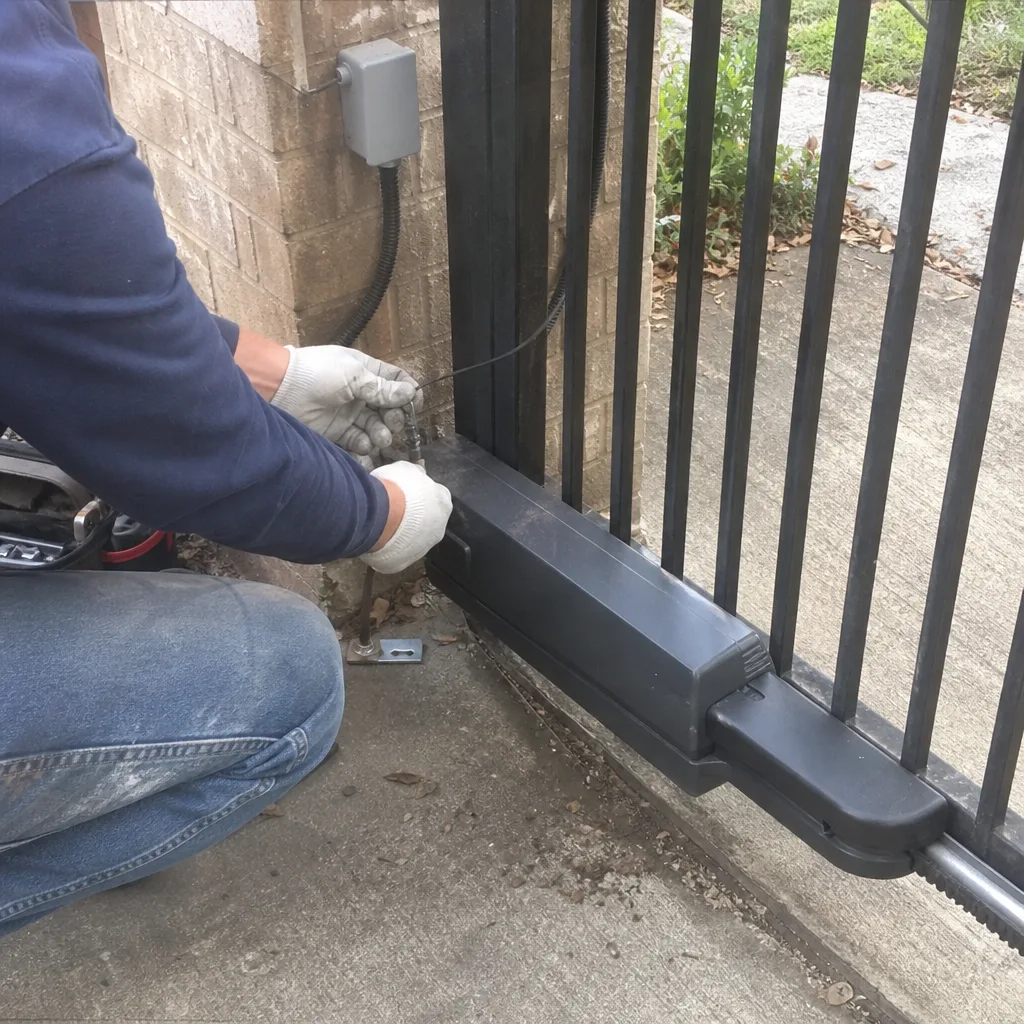
Every three months for the measurement-based checklist, with additional checks after freeze events, heavy rains, or anything that physically moves the gate. Summer months may justify monthly battery voltage checks because of heat stress on the operator housing.
A multimeter, a steel ruler or feeler gauge, a camera phone, and a notebook or spreadsheet. That’s the whole kit. You don’t need special gate tools to record measurements. You need tools to fix problems, and that’s where a professional comes in.
Regular inspection and measurement by a homeowner costs nothing but time. A professional maintenance visit in League City typically runs between $85 and $150 for a single gate, depending on whether it’s a swing or sliding gate and how many components need adjustment. Any repair work discovered during maintenance is quoted separately in writing before it starts.
No. WD-40 is a water displacement product, not a long-term lubricant for gate chains. It evaporates quickly and leaves a thin, sticky residue that attracts dust. Use a silicone spray or dry chain lube on chain drives, and a light machine oil on hinge pins. Call (346) 787-1751 if you’re not sure what product matches your gate’s components.
In League City, the most common causes are photo-eye misalignment from post movement, sun washout on south-facing installations in winter, or a failing backup battery that drops voltage under load. Record the time of day and temperature when it happens. That pattern is the diagnostic clue that tells a technician which cause is most likely.
A full record includes dated measurements for hinge gap or track clearance, battery float voltage, limit-switch position, photo-eye LED status, and any error codes or cycle counts from the operator board, plus photographs of each measured component with a reference object in frame. That’s the same information we document on every professional visit, and it’s what makes the next repair faster and cheaper. For a complete look at what we check, our Gate Motor & Opener in League City guide covers the operator diagnostics in detail.
The Bottom Line
A gate maintenance checklist that only says “check and lubricate” isn’t worth the paper it’s written on. The checklist that protects your investment, shortens emergency calls, and lowers your repair costs is the one that records numbers. Hinge gap. Battery voltage. Limit-switch travel. Photo-eye alignment. Date. Temperature. Photo. Done. League City’s climate punishes gates that aren’t documented, and rewards the homeowners who write it down. If you’re not sure where to start or you want a professional baseline from someone who’ll write it all down and hand it to you, that’s exactly what we do. For more guides & resources, explore our blog.
Written by Adrian Vance, Owner at Vance Gate Repair League City, serving League City since 2014.