
Last updated September 20, 2026
Free on-site gate assessment - hinges, posts, and your LiftMaster or Nice gate operator checked before anything is quoted
The assessment is free and the quote is the invoice.




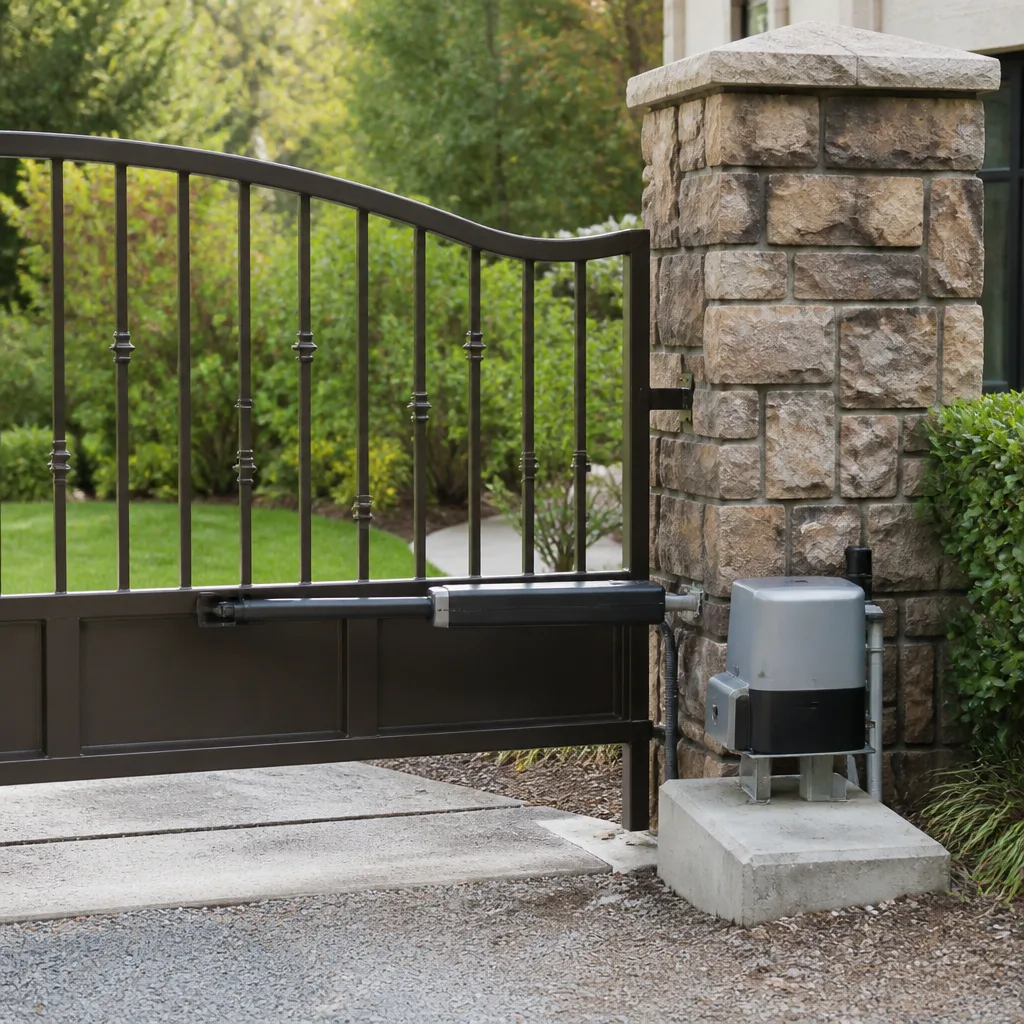
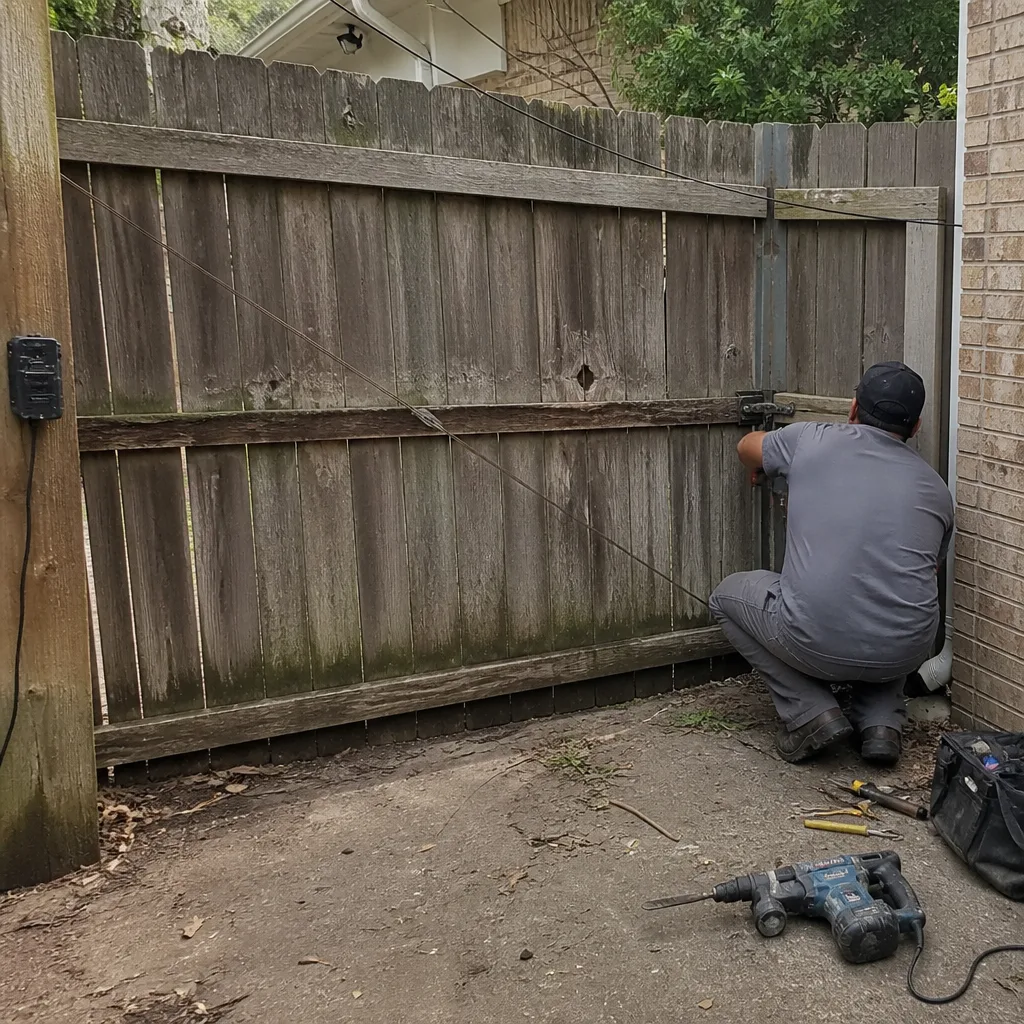 Before
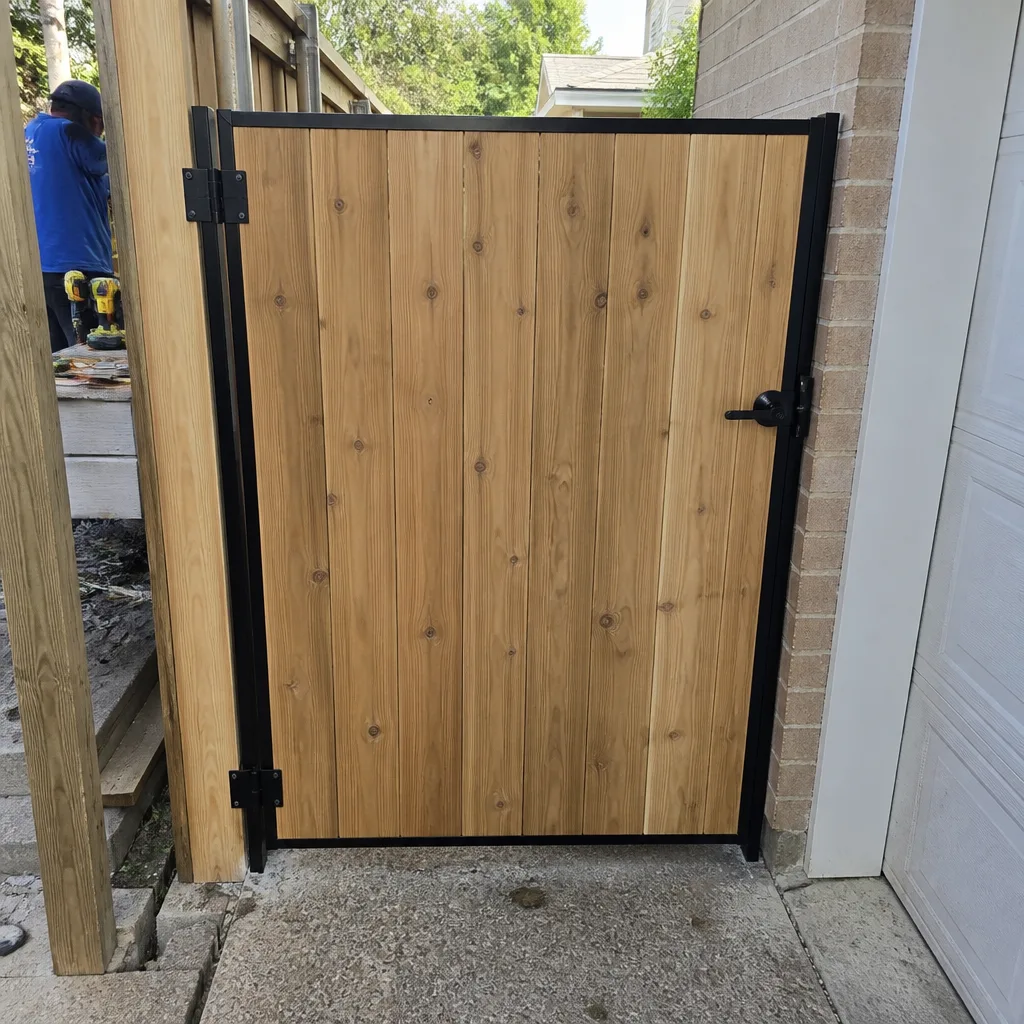 After
After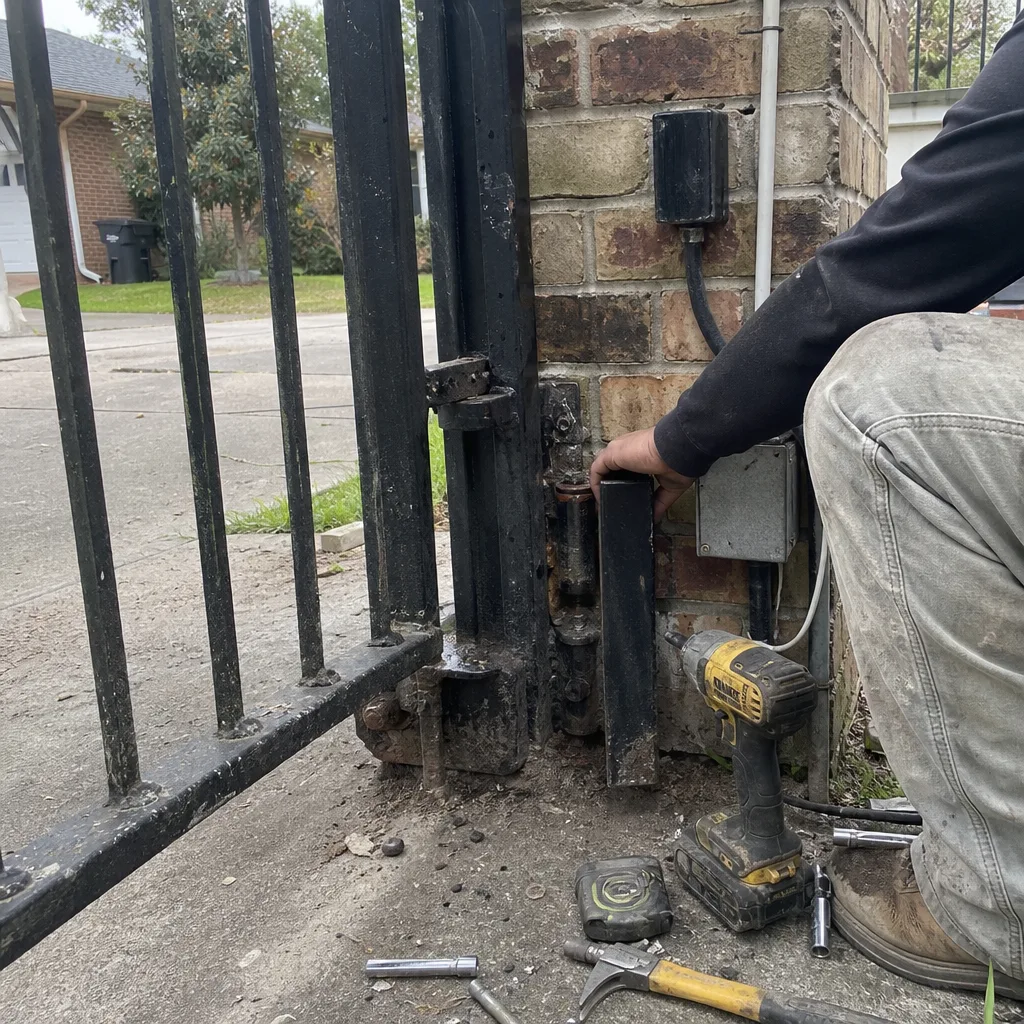 Before
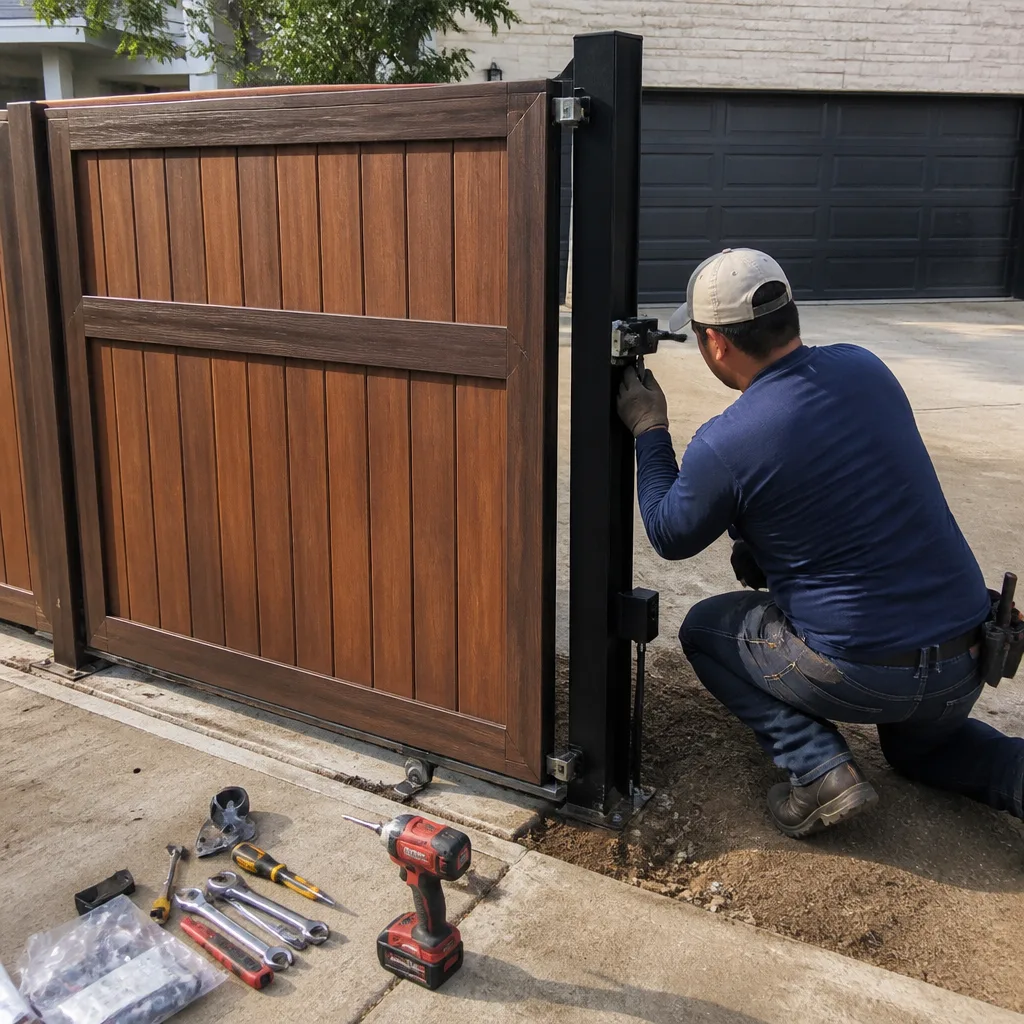 After
After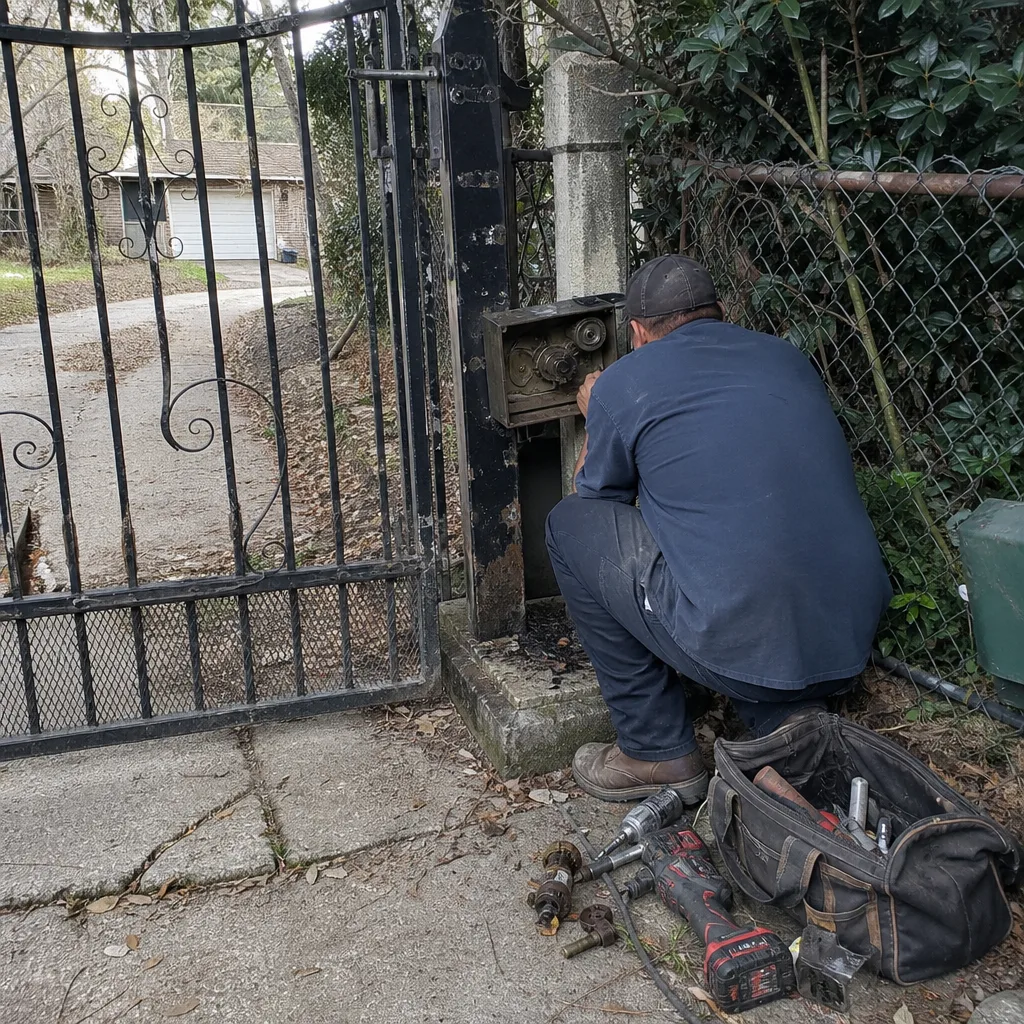 Before
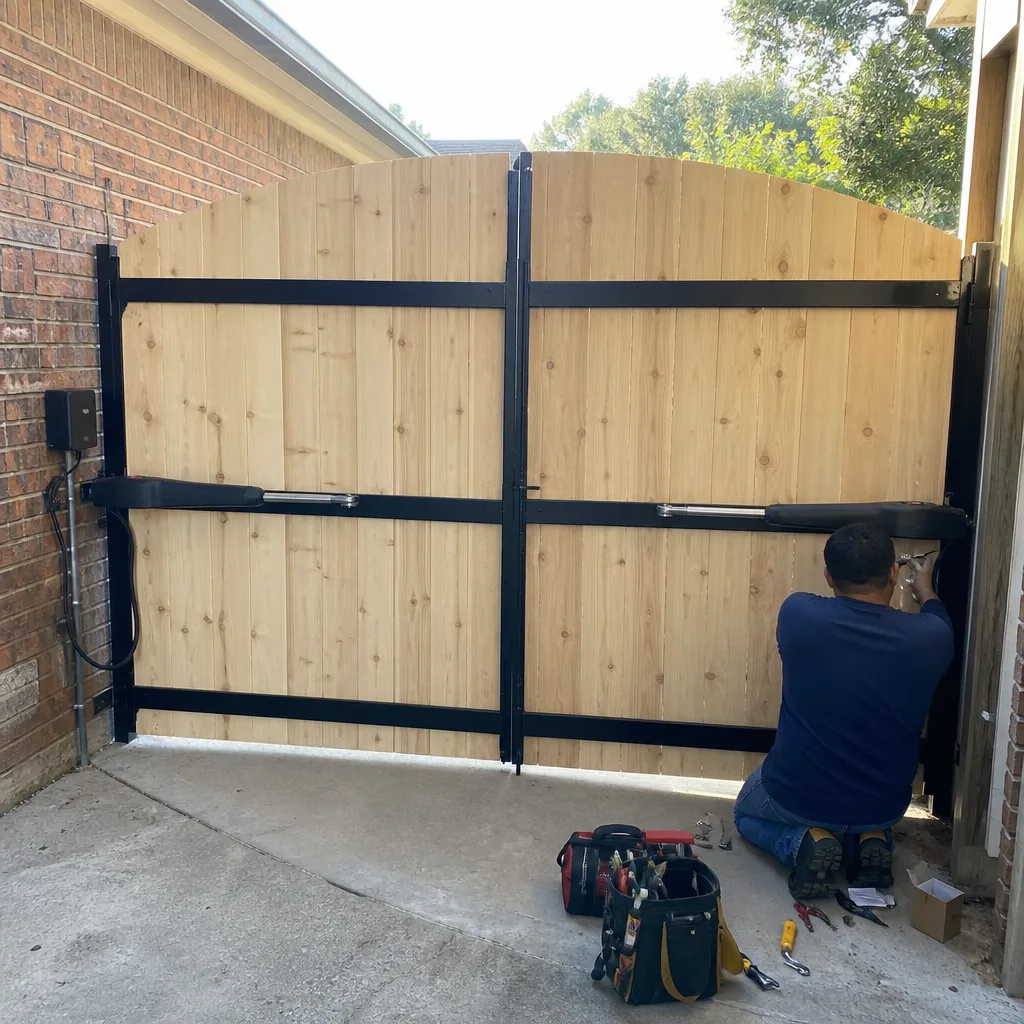 After
AfterDIY vs Professional Gate Repair: The League City Homeowner’s Decision Guide
Here’s a number most DIY gate guides won’t tell you: a replacement hinge for a residential swing gate costs about $18 to $40, and installing it yourself saves roughly $120 in labor. A misadjusted open-force setting on a gate operator costs nothing to “fix” and can create liability exposure that runs into six figures if the gate closes on a person. Both jobs look similar on YouTube. Legally and financially, they are not even close. This guide draws the actual line between the two, using League City’s climate, soil, and gate stock as the reference point, so you know which repairs you can safely own and which ones need a written record from a licensed pro.
Quick Answer
League City homeowners can safely handle lubrication, visual inspection, sensor cleaning, battery replacement, and cosmetic fixes on their own gate. Work that touches the operator’s internal force settings, photo-eye alignment, safety edges, or any component governed by UL 325 safety standards should be done by a professional because DIY changes to those parts create personal liability if the gate later injures someone. The hidden risk isn’t the quality of your work; it’s what happens in a lawsuit when you can’t produce a dated service record showing the system met federal safety standards.
Table of Contents
- The UL 325 Line: Where DIY Legally Ends
- What League City Homeowners Can Safely Do Themselves
- Work That Requires a Documented Professional Visit
- The Hidden Cost of Successful DIY Repairs
- What Tools You Actually Need for the Safe DIY Tasks
- How to Document Your Own DIY Work So It Has Value
- League City Factors That Change the Repair Equation
- Common Mistakes to Avoid
- When to Call a Professional
- Frequently Asked Questions
BeforeAfterThe UL 325 Line: Where DIY Legally Ends
UL 325 is a federal safety standard that governs automatic gate operators. It establishes requirements for entrapment protection, force limits, and safety devices like photo-eyes and contact edges. The standard exists because automatic gates have killed people, and when an injury or death occurs, the legal process asks one question first: who last worked on the system, and do they have a documented record of what they did?
If you adjusted your own open-force settings three months before an incident, you are the last documented party. You have no service record, no calibration reading, no signed invoice showing the work met UL 325 thresholds. You are personally exposed. When a gate company does the same adjustment, the signed invoice transfers that liability to the company’s insurance policy. That’s not a marketing claim; it’s how premises liability works in Texas.
In our experience across Gate Repair in League City, the specific tasks that cross into UL 325 territory include:
- Force-setting adjustments – changing how hard the operator pushes the gate before it reverses. UL 325 sets maximum allowable force. A homeowner with a screwdriver has no way to measure compliance without a force gauge.
- Photo-eye alignment or replacement – a photo-eye (the infrared beam that stops the gate if something crosses the path) that is misaligned by even an inch or two can create an entrapment zone.
- Safety edge installation or repair – the pressure-sensitive strip on the gate’s leading edge, designed to reverse the gate on contact.
- Operator logic board replacement – the circuit board that governs safety timers, reversal logic, and sensor interlocks.
- Close-limit switch adjustment – setting where the gate stops at full close. Too far into the post and you create a crush point.
None of these are hard to understand. They are hard to prove safe without the right instruments and a dated, signed record. That’s the entire distinction.
What League City Homeowners Can Safely Do Themselves
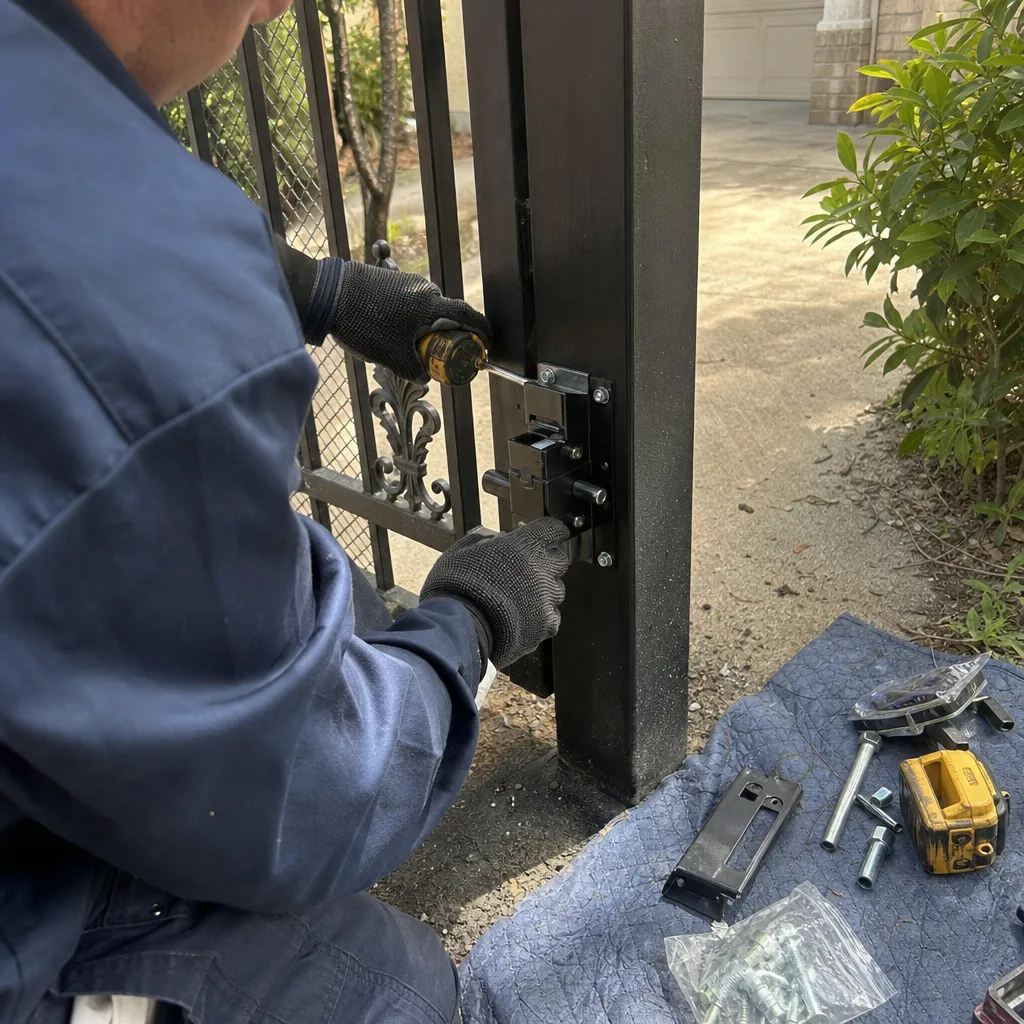
The good news: a meaningful portion of routine gate maintenance is genuinely DIY territory, and doing it yourself extends the life of your gate and operator in League City’s salt-air and humidity conditions. These tasks carry no UL 325 liability because they don’t touch the safety system.
Here’s the honest list of safe DIY work, with the Vance Gate Repair League City home perspective on what each task actually accomplishes:
1. Lubrication of hinges, rollers, and chains
Every three to four months in League City’s humidity, apply a silicone-based lubricant to swing-gate hinges and slide-gate rollers. Avoid WD-40 as the primary lubricant; it cleans but doesn’t leave a lasting film. Use a white lithium grease on steel hinges and a dry silicone spray on nylon rollers. This is the single highest-value DIY task. Lubrication that happens on a schedule prevents most mechanical gate repairs entirely.
2. Visual inspection of the gate frame and mounting hardware
Walk the gate once a month and look for rust at weld points, loose bracket bolts, sag in the gate leaf, and wear on the chain or belt. League City’s coastal proximity means steel gates rust faster than the same gate would in Dallas or Houston proper. Catch rust before it penetrates the tube wall. Wire brush it, prime it, and touch up with rust-inhibiting paint.
3. Cleaning photo-eye lenses
This is safe even though photo-eyes are safety devices. Cleaning the lens with a soft cloth and glass cleaner is maintenance, not adjustment. If cleaning doesn’t restore function, stop. The alignment itself is pro territory.
4. Battery replacement in solar-powered operators
Many League City homes run swing gates on solar-charged battery systems, particularly in the newer subdivisions where running conduit is expensive. If your operator runs on a 12V battery, swapping a dead battery for an identical replacement is safe DIY work, provided you disconnect solar input first and photograph the terminal connections before removing them. Use the same battery chemistry and amp-hour rating that was in there.
5. Cosmetic work: paint, trim, and vegetation clearance
Painting the gate, replacing decorative caps, and clearing vines and brush from the gate track are all safe. Keep vegetation off the gate path and away from the photo-eye beam line. League City’s growing season means a clear path in March is overgrown by June. It’s a monthly check, not an annual one.
For any task on this list, a gate installation or repair professional would charge a service call plus labor. Saving that money is legitimate. The key is staying on this list and not drifting one step further into adjustment territory.
Work That Requires a Documented Professional Visit
The line here is not about skill. Plenty of League City homeowners possess the mechanical aptitude to change out a Viking control board or re-tension a Ghost Controls arm. The line is about documentation and liability transfer. When a technician touches these components, they create a dated, signed record that the work met UL 325 requirements. That record is a legal asset. Your DIY work, no matter how competent, cannot create that asset.
Professional territory includes:
- Any operator internal repair – force settings, limit switches, logic boards, capacitor replacement, transformer work. If the cover comes off the operator, it is now pro work.
- Photo-eye replacement or realignment – this is not just bracket adjustment. Beam alignment affects the entrapment-protection zone, and a misaligned beam can mean the gate continues closing on an obstruction.
- Safety edge replacement – requires matching the contact strip to the operator’s input impedance, routing the wiring through the gate frame, and testing the reversal under load.
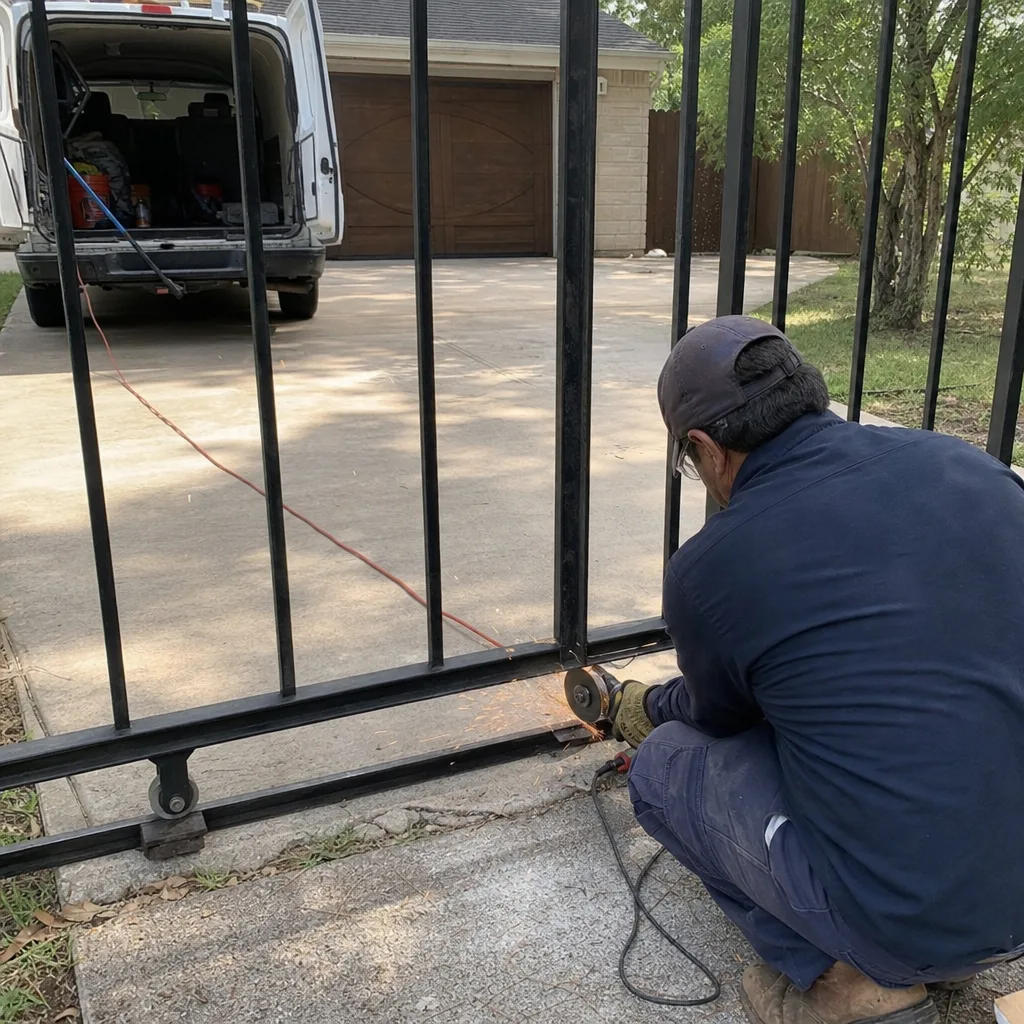
- Gate leaf re-leveling on sagging hinges – this isn’t just adjusting a hinge bolt. Gate sag is often a sign of post movement in League City’s clay-heavy soil, which expands and contracts through wet-dry cycles more aggressively than the sandier soils closer to Galveston Bay. Re-leveling may require welding new hinge plates or re-setting the post.
- Motor or gearbox replacement on any of the major brands – DoorKing, Elite, Viking, or others. These jobs require matching the replacement unit to the gate’s weight, cycle duty, and voltage requirements.
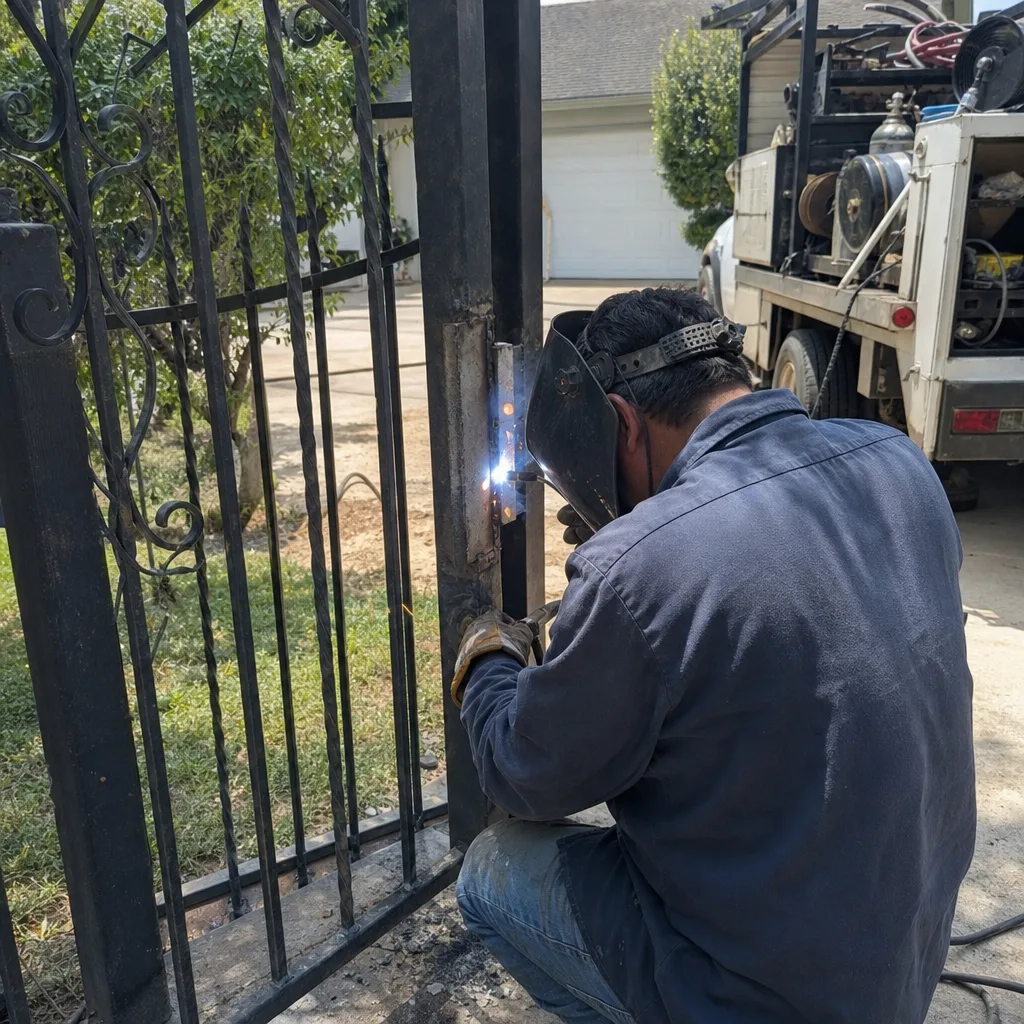
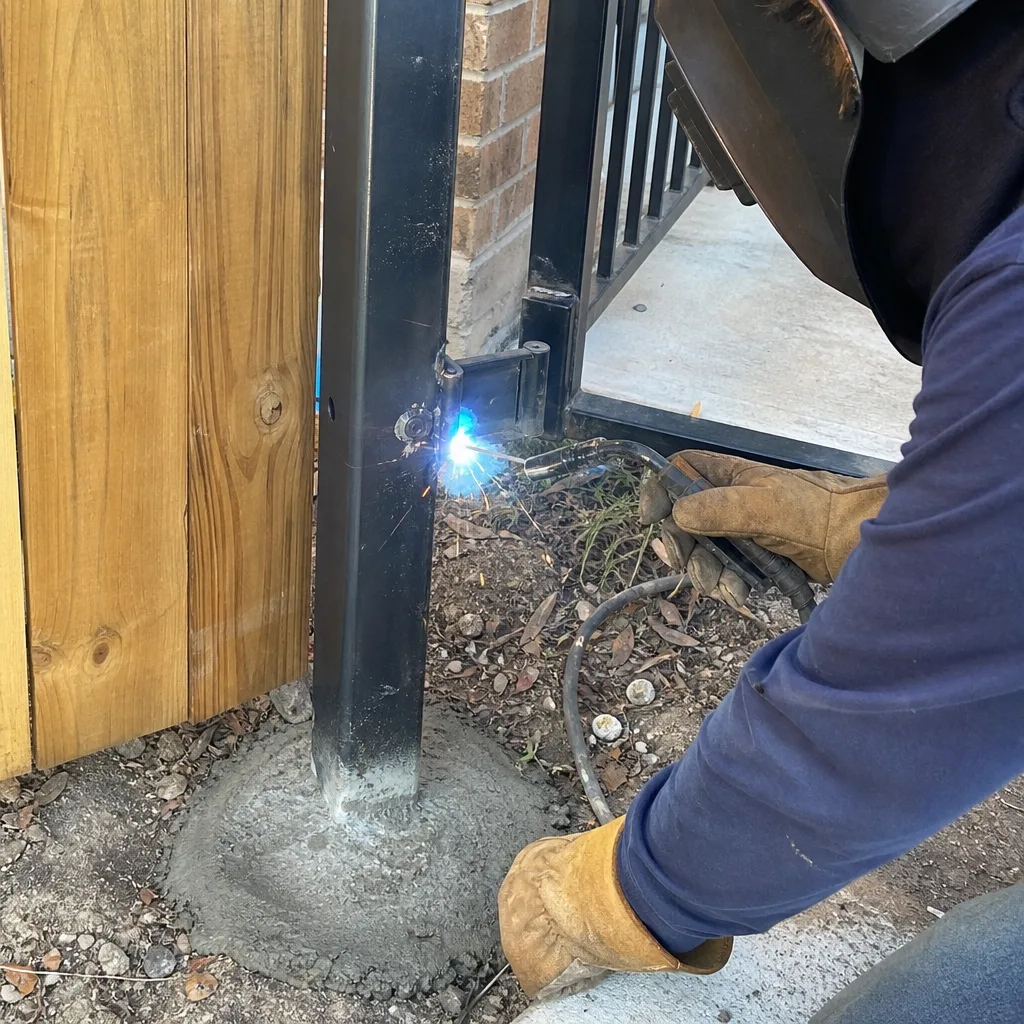
- Any repair involving welding – cracked weld points on steel gate frames, broken hinge brackets, or gate leaf separation. Welding changes the structural load path, and a bad weld on a heavy gate is a structural failure waiting to happen.
For any work in this category on a Gate Motor & Opener in League City, the professional’s invoice is doing two jobs at once: it is a repair record and a liability transfer. That’s what you’re paying for beyond the labor itself.
The Hidden Cost of Successful DIY Repairs
Here’s the part most guides skip. Suppose you successfully replace your own operator’s capacitor and the gate runs. No safety issue, no liability, the work is clean. A year later, a different problem appears: the gate reverses randomly at mid-travel. You can’t diagnose it. A technician from gate repair in League City arrives and starts at zero. They don’t know a capacitor was replaced, what value was used, whether the wiring is factory-standard, or whether the random reversal is related to that previous repair.
So they charge diagnostic time to rediscover what was already known but never recorded. That’s the hidden cost. Had the homeowner left a two-line note inside the operator housing – “Capacitor replaced 3/2026, 50μF 370V, wire color unchanged” – the diagnostic path would be shorter. Without it, the technician is doing archaeology.
You can prevent this. The fix is documentation, not avoidance of DIY. We’ll cover exactly what to record in the next section.
What Tools You Actually Need for the Safe DIY Tasks
Most gate repair tasks don’t require a specialty tool wall. The safe DIY list above can be completed with a basic tool set that most League City homeowners already own or can assemble for under $100. Conversely, some tools look relevant to gate work but are unnecessary for the safe tasks, and buying them is wasted money.
What you need:
- Socket set with metric and SAE sizes – 10mm through 19mm covers most hinge bolts, bracket bolts, and terminal nuts on residential gates. You’ll use the 13mm the most.
- Allen key set – required for set screws on hinge barrels and for tightening guide brackets on slide gates. Most residential gates use 4mm through 8mm Allen set screws.
- Silicone-based spray lubricant – for rollers and nylon parts.
- White lithium grease in a tube – for hinge barrels and steel-on-steel pivot points.
- Wire brush and rust-inhibiting primer – for rust spot treatment before it becomes a structural issue.
- A digital multimeter – only if you’re doing solar battery replacement. You’ll use it to confirm the battery reads 12.6+ volts at rest before installing. Anything beyond voltage checking on the battery is pro territory.
- Your phone camera – for the documentation protocol below.
What you do NOT need to buy:
- A torque wrench – hinge bolts on residential gates are tightened to “firm plus a quarter turn,” not to a factory spec. Save the $80.
- Specialty gate tools from online retailers – the “complete gate repair tool kit” listings are mostly sockets you already own plus a $40 markup.
- A force gauge – this is the tool used to confirm UL 325 force compliance. It costs $300 to $600 and requires calibration. You will use it once. If you’re at the point where you need a force gauge, you’re past the DIY boundary anyway.
How to Document Your Own DIY Work So It Has Value
Turn your DIY repair into usable service history. The habit is simple and costs nothing: photograph before, during, and after, and write a note that answers the four questions a future technician would ask. This is the same documentation instinct that drives Vance Gate Repair‘s commercial work, and every homeowner can adopt it for their own repairs in about five minutes per job.
Here’s the exact protocol for any DIY gate task:
- Photograph the area before you touch anything. Wide shot of the gate and operator, close-up of the specific component. This gives the next technician a reference for original condition.
- Photograph any part number or label you can see. Operator model tag, motor plate, battery label, capacitor marking. These become the Rosetta Stone for future parts matching.
- Photograph the work in progress. Wires before disconnection, bracket position before removal, bolt pattern before disassembly. These photos are worth more than the “before” shot because they show exact wiring order and mechanical position.
- After the repair, photograph the completed work. New part in place, wire colors visible, final bracket alignment.
- Write a two or three line note. Include: date, what was replaced or adjusted, the exact part number or specification, and any deviation from original condition. Example: “Replaced gate opener battery 3/14/2026. Old: 12V 18Ah SLA. New: identical. Terminals photographed, no wiring changes.”
- Store the note and photos where they’ll be found. For operators, a zip-top bag taped inside the operator housing works. For gate hardware, a note in your home file plus photos in a dedicated phone album. Send a copy to your own email with the subject line “Gate repair [date]” so it’s searchable.
This record is not legally equivalent to a technician’s invoice under UL 325 – don’t mistake it for that. But for the safe DIY tasks where no UL 325 issue exists, it transforms random homeowner tinkering into a service log that a future technician can build on without starting from zero. In League City gate repair work specifically, we see the difference every week: a documented history shortens diagnostic time by half or more.
League City Factors That Change the Repair Equation
Gate problems in League City are not the same as gate problems in Katy or Pearland. Local conditions change failure patterns in specific, predictable ways. Knowing these patterns helps you prioritize which DIY tasks matter and which failures are inevitable enough to warrant professional intervention.
Salt air and coastal humidity
League City sits roughly twenty minutes from Galveston Bay, close enough for salt-laden breeze to accelerate steel corrosion, especially in the Clear Creek and west League City areas closer to the water. Zinc-plated hardware that lasts decades in Dallas lasts five to seven years here. Galvanized and powder-coated gates hold up better, but the hardware at the hinge points and the exposed welds remain vulnerable. Monthly rust inspection is not optional here; it’s the difference between catching surface oxidation and replacing a gate leaf that rusted through at the weld joint.
Clay soil movement
League City soil is dominated by vertisolic clay – the same expansive clay that creates foundation movement across the Gulf Coast. This clay swells when wet and shrinks when dry, and it moves gate posts. In the South Shore Harbour and Newport subdivisions, we’ve regularly seen driveway gate posts shift enough over a single wet-dry season to cause gate leaf misalignment and striker plate binding. This is not a hinge problem. It’s a post problem, and it often requires re-setting the post in concrete or adding a concrete footer tie-in. No amount of hinge adjustment fixes a moving post.
Storm cycles and flood exposure
League City’s position near Clear Creek and Galveston Bay means flood considerations are part of gate ownership. Slide-gate track systems installed at grade level are particularly vulnerable to silt and debris accumulation after heavy rain events. If your gate runs on a track, post-storm cleaning of the track bed is safe DIY work that prevents premature wheel and track wear. Doing it after every significant rain event during hurricane season is the right cadence.
Solar and battery landscape
Because League City’s newer subdivisions – Westover Park, Victory Lakes, Mar Bella – include a high proportion of properties with long driveways and detached garages, solar-powered gate operators are common. These systems live and die by the health of their batteries and the solar charge controller. Battery replacement is the safe DIY task described earlier. Charge controller replacement is not. If your solar system is not holding charge and a fresh battery doesn’t fix it, the controller or panel is the culprit, and that’s a professional diagnosis.
Common Mistakes to Avoid
- Treating force-setting adjustments as a “quick fix” for a sluggish gate. A gate that struggles to open is telling you something: dying motor, bad capacitor, binding hinge, low voltage. Raising the force setting bypasses the symptom without addressing the cause, and it puts you out of UL 325 compliance in the process. This is the single most dangerous DIY shortcut on a residential gate.
- Using WD-40 as your gate lubricant. WD-40 cleans and temporarily frees, but it doesn’t leave a durable film. In League City’s humidity, hinges lubricated only with WD-40 are dry again within weeks and now have no rust protection from their previous lubricant layer. Use lithium grease or silicone spray for lasting results.
- Ignoring the photo-eye because “the gate still opens and closes fine.” The photo-eye is not a convenience feature; it’s the primary entrapment protection on most operators. A misaligned or dirty photo-eye that the system has “learned” to ignore (on some older DoorKing and Elite boards) means your gate has no non-contact entrapment safety. That’s a legal exposure you own.
- Adjusting a gate leaf by shimming hinges instead of investigating post movement. In League City’s clay soil, gate sag is often a symptom of post shift, not hinge wear. Shimming the hinge masks the post movement for a few months while the real problem worsens. The DIY inspection should ask why the gate moved, not just compensate for the movement.
- Replacing an operator battery with a different chemistry or capacity. Mixing battery types – replacing a sealed lead-acid battery with a lithium pack, for example – can damage the charge controller or create improper charging behavior. Match the existing battery exactly. If you want to change chemistry, that’s a professional conversation about whether the charge controller supports it.
- Doing a DIY capacitor replacement on the operator with no record and no parts verification. The capacitor on a gate operator stores high voltage even after power is disconnected. If you don’t know how to discharge it safely, this task is not safe DIY. If you do know how and you complete the job without documenting the part number and date, you’ve added hidden diagnostic cost for the next repair. Two separate problems, both avoidable.
- Assuming a gate that runs on manual mode is still “safe” after an operator failure. When an operator fails and the gate runs manually, the safety devices are also out of the loop unless the manual release is fully disengaged. A heavy gate free-swinging in the wind with no stop and no reversal sensor is itself a hazard. Lock the gate in position until the operator is repaired.
When to Call a Professional
The threshold for professional help is clear: the moment the work touches a UL 325-governed component, the liability math changes. That means any repair inside the operator housing, any photo-eye or safety-edge service, any welding on the gate structure, and any diagnosis involving post movement. You’re not paying for expertise alone. You’re paying for the signed invoice that says the work was done by a documented professional to a safety standard.
Vance Gate Repair League City offers free estimates in League City. Call (346) 787-1751 and a live person answers, any hour. The written price comes before any work starts, and every visit includes a documented photo record of what was found, what was adjusted, and what was replaced.
Frequently Asked Questions
Most gate repair in League City runs between $125 and $450 for typical mechanical or electrical faults. Hinge replacement on a swing gate typically runs $140 to $280 including parts and labor. A photo-eye replacement typically runs $160 to $320 depending on the operator brand. Full operator motor replacement runs $600 to $1,600 depending on the unit and whether the mounting bracket is reusable. Every one of these is quoted in writing before work starts. Call (346) 787-1751 for an exact quote on your specific gate.
For gate repair in League City, most mechanical and electrical faults are same-day calls, because the parts are common and the diagnosis is usually quick. Emergency situations, like a gate stuck open or an operator that won’t respond, are handled immediately. Call anytime; a live person answers (346) 787-1751 24 hours a day.
No, and the reason is not about skill. Open-force adjustments, limit settings, and photo-eye alignment are UL 325-governed safety parameters. A homeowner who adjusts these settings without a calibrated force gauge and without a documented record is personally liable if the gate later injures someone. This is the one category of gate work where DIY is never the cost-effective option.
First, run the safe DIY checks: lubricate all hinge points, confirm the gate leaf is not dragging on the ground, and clear any debris from the track or hinge path. If the gate still moves slowly after those steps, the problem is internal to the operator or the drive mechanism, which is pro territory. In League City specifically, check for clay-driven post movement as a possible cause of binding. Call (346) 787-1751 for a written diagnosis if the simple fixes don’t resolve it.
Every repair includes a written price before work starts, the repair itself, a documented photo record of what was found and what was replaced, and a written record of every adjustment made. Under The Haven Standard‘s Clause 4, the photo record is included at no additional charge on every visit. The 365-Day Done Right Promise covers the repair for a full year.
Four conditions make a gate problem urgent: the gate is stuck open and cannot be secured, the gate is stuck closed and blocks vehicle access, the operator is making grinding or popping sounds that indicate mechanical failure in progress, or the safety devices are non-functional while the operator still runs. Each of these creates a risk or an access problem that shouldn’t wait. Call (346) 787-1751 and a live person will answer, regardless of the hour.
The Bottom Line
Do the maintenance. Leave the safety systems to someone with a license, a force gauge, and an invoice that transfers liability. The DIY-safe list on a League City gate covers lubrication, rust treatment, visual inspection, photo-eye lens cleaning, battery replacement, and vegetation control. Everything else – operator internals, photo-eye alignment, safety edges, welding, post re-setting – belongs in professional hands, and the reason is legal, not technical. Document what you do, photograph everything, and when the job crosses the UL 325 line, call (346) 787-1751. The estimate is free, the price is in writing before work begins, and the record comes with the repair.
Written by Adrian Vance, Owner at Vance Gate Repair League City, serving League City since 2014.